Showing posts with label Projects. Show all posts

February 13, 2024

Tidbit: Diesel Fireplace Heater- Tips for Installation and Use

This is one of a series of brief, no nonsense posts that we call a Tidbit:

noun; small and [possibly] particularly interesting items of gossip or information...
The purpose is to share succinct posts about lessons learned, or things we use or do that work [or don't...] that are common to many of us boaters. 

The goal is to garner feedback from those of you having first-hand experience with a better approach/ solution/ product...  
We never assume what we are sharing is the ideal or only; it just seems to best suit our needs [and/or habits and/or budget] from our experiences thus far...
Sometimes these Tidbits originate from a topic of discussion on one of the forums we participate in, and this happens to be one. [The original forum response- which includes additional details- is linked below.]

Since we encounter this question fairly often- and since it may affect other boaters- it made sense to post a more detailed response for future reference.

                   ➛ ➛ Peruse the right-hand sidebar for the up-to-date list of Tidbits ➛ ➛                   


It is rare to find a vessel that doesn't have some type of non forced-air diesel heater up here. 

Some people report continuing issues with sooting on deck using this kind of heater.

This post is a quick brain dump listing installation and usage parameters I have found to help minimize sooting. I ​rarely see any dirty decks​- ​but it can happen.​ 

Below I'll list the ranked causes of sooting with this kind of heater that I've experienced​ over time.

​I have had heaters like this on 4 of 5 boats I've owned over the past 4 decades. All were full time cruisers I used in higher latitudes. (>56°N in the Pacific.)​


​In Fall 2021 installed a​ Sig Marine 120 (pretty equivalent to the Dickinson Newport) ​on our current boat. In winter it ​is only been off a handful of times (when the boat is unoccupied) since November while we work on some winter projects at the dock. No soot. No backdrafting. (But we have been using this type of heater in 4 boats over the past 4 decades, so the learning curve is well absorbed.)

We find the heater output is too much in our 43 ft ​ketch if ambient temps are ​in the 40's °F. We then have to open ports and hatches to keep from overheating on the lowest setting- ​if we do light it in those temps...​ (This boat has several redundant sources of heat.)​

Our ​SIGMAR ​heater is on the lowest setting most of the time- ​sometimes elevated ​closer ​to a medium setting when ​its single digits above zero F and blowing outside...

What ​experience can I share specifically about this size and type of heater with a 3" flue​?​ (Following is a ​dense ​​overview full of hints about things I think I have learned over time- only for those truly interested...)

Here is Dickinson's version for reference.


Installation is important:
  • Keep ​the total ​flue length ​a ​minimum of 6 ft, max of 8 ft

  • Straight flue is best. 
    • ​I​f you must dog​-​leg​ the​ flue​, don't use more than 2 elbows, and use the smallest angle you can- with nothing greater than 45°.
The barometric damper is properly adjusted in this photo of the heater in use.

The shield installed on top of the angled flue [to help shield the headliner]  and the vertical solid filler [right in photo] behind the perforated flue guard [left, but not showing much in this photo, but is prominent in the first photo of this post] were both fashioned from pieces cut from a single snap together 3" SS flue pipe.

  • Install a barometric damper​ [see above photo]
    • Locate it​ no further than 24 inches from where the flue exits the heater​, and no closer to the heater than 12 inches. 
      • Be sure they are improperly installed and adjusted.
        • Carefully adjust the ​barometric ​damper per manufacturer's instructions​ (I inserted a photo of our barometric damper with the heater on low, above, for reference.)​
      • Most complaints about sooting are about installs lacking a barometric damper (and occasionally from improper adjustment of one that is installed.)
    • Use an H cap​ (Charley-Nobel) in breezy conditions​. We have found it to be consistently better at handling wind gusts than the round version​ (in our testing and experience​.)
      
    This is our typical flue set-up if expecting windy conditions. The flue extension length was determined by testing different lengths and caps during the same steady 20kt wind conditions. 

    As mentioned in the main text, this 3" flue gets covered with a 4" flue sleave [note to self; need photo...] in cold weather to help maintain inner flue temperature, and consequently draft. [This 4" flue cover adds the side benefit of being cooler, and thus less threatening to bare skin and meltable fabrics the crew might be wearing in winter.]

    We remove the flue and cap it off when not at anchor or at the dock; photo further down.


    ​ We sometimes use a round cap in calm conditions- typically fringe heating season overnighters.

    • If planning to use the heater in temps cooler than about +20°F [-7°C] for extended periods, have a length of larger diameter flue pipe [4 inch diameter covers our main 3 inch flue well] you can ​temporarily ​slide over the primary flue above deck to provide a layer of insulation- helping ​to ​keep the main flue warm​ to promote a consistent draft in cold weather.​
      • This insuilating sleave adds the side benefit of being cooler, and thus less threatening to bare skin and meltable fabrics the crew might be wearing in winter.
    • Duct combustion air from ​an ​enclosed, vented space (our's draws from the engine room. This is where the bulk of the soot will go if you ever suffer an extreme backdraft.​ More below.)​

    • Install a gravity feed day tank if you don't want to listen to a fuel pump burp every second or so while running the heater.
      • Install a valve on the tank before the fuel hose.

        (Our day tank is filled by the 12 volt fuel pump that runs the tank transfer/polishing loop.)
      • The day tank overflows back into the starboard fuel tank when full.
      • Install a small shut-off valve at the fuel inlet on the heater. Develop the habit of closing it when the heater is off.

        This is a safety against fuel flowing through the overflow- draining the day tank- in the future when the small o-ring on the carburetor needle valve tip fails. (Ask me how I know this.)
    • ​Run the overflow from the carburetor to the fuel tank if possible (vs. an overflow bottle.)

      If you do this, install a valve on that port on the heater, and remember to close that valve temporarily when fueling the tank the return goes to- but only if you don't want to back-fill the heater if you overfill the boat. (i.e., fuel up the fuel fill hose- which will be higher than the heater carburetor...)​

    • ​Remove the above deck portion of the flue when the heater is not in use for extended periods, and always before getting underway.

      Secure the flue opening with the water tight cap made for the through-deck fitting installed on your boat.


    Operational considerations:

    • #1 diesel (AKA Heating oil​;​ kerosene​)​ burns much cleaner than #2 (The carburetor must be adjusted to match fuel selected​. See manufacturer's instructions.​)

    • When first turning on fuel after preheat, ​set to medium ​flame size for at least 10 mins to warm the heater and flue. Then start turning ​it ​up/ down a little bit at a time- pausing a few minuites between adjustments for the heater to equilibrate to the new setting.​ (This is not a thermostat; it is a fuel flow meter... give the heater time to adjust to each new setting.​)

    What causes sooting? (Note that sooting either vents out of flue top onto the deck, or when back​ ​pressured into boat via the combustion air intake in the bottom of the heater.)​ If [when?] it happens, either Krud Kutter, Davis FSR, and Someone To Do It cream cleaner are the magical soot removers...

    Following are the primary reasons sooting occurs, in order of their occurrence from my experience.​
    • Cause #1: Preheating the heater using diesel fuel ​with a tissue paper ​wick as the manual instructs. This causes a build up of soot in the flue and in the bottom of the burn chamber over time.

      Instead, we use ab​o​ut 3/4 of an ounce of denatured alcohol [AKA alcohol stove fuel; typically available where paint is sold]- and​ a long neck lighter instead of​ tissue paper​​ to ignite it. We​ pour the alcohol into the middle of the COLD heater chamber, turn ​the ​combustion air fan on low; lite ​the ​alcohol​ (the fan being on keeps the alcohol from 'poofing' when you light it.)​ When the alcohol flame starts going below the burner ring​ (​2-3 mins on average​) turn on the fuel flow to a medium setting, and t​urn off ​the ​combustion air fan​ (​unless it is blowing outside... more on that, below.​)​

    • Cause #2: On our stove, we ALWAYS make sure the flame is above the 'top burner ring' otherwise there is too much combustion air and not enough fuel = soot. Slightly increase the fuel flow to correct this issue.

      Side Note: that top burner ring is removable. Don't assume it is installed correctly. It can also cause a miriad of flame and soot issues if incorrectly installed. (Read the manual!)

    • Cause #3: Too much fuel and not enough combustion air = SOOT! (i.e., Too large of a flame.)

      Either decrease fuel flow, or turn the combustion air fan on and adjust the air flow to optimize the flame.

      I believe this is the #1 cause of sooting on deck: people turning the heater up too high in hopes of heating the boat faster.

    • Related Cause #3.5: As the heater warms after being first lit, in a few hours the carburetor will warm, thinning the fuel it contains, thereby causing the fuel to flow faster. This results in the flame size slowly increasing- perhaps unnoticed- and possibly getting large enough to cause sooting as described in #3.

      Be aware of this, and keep an eye on the flame. Always.

    • Cause #4: Rapid wind gusts (over 35 knots for our installation) COMBINED with negative static pressure inside the boat​​ can snuff out the flame and cause a woof when the still flowing fuel reignites in the hot burn chamber- blowing soot out every small crack and the flue and air intake openings. This is the most dreaded.

      It ​sometimes ​happens to us when we experience katabatic gusts (williwaws)- typically in glacial fjords in certain conditions. Think zero to 60 knots in ​under 10​ seconds.​

      S​ometimes ​slightly opening a hatch or port will help ​prevent a negative static pressure inside the boat ​in catabatic conditions​; ​and sometimes turning on the combustion air fan​ ​and increasing its speed to balance the wind gusts​-​ or a combination- ​helps prevent the flameouts.​
    • Cause #5: [A minor contributor] When turning off the heater (by stopping the flow of fuel) turn the combustion fan on low for the few minutes [~10] it takes for the flame to completely extinguish. (A tiny flame flickers in the bottom of the burn pot for several minutes- burning off residule fuel.) Running the combustion fan during cool-down helps prevent small amounts of soot and smoke, and clears fuel odors from the heater.

    I hope this quick brain dump is useful, and that I didn't forget anything critical.

    These heaters are very ​safe if installed properly, and ​worthwhile if you ​are patient enough to learn how to use them. It is important to be very observant as you go through the learning curve of using and adjusting this type of heater​, and develop the habit of scrutinizing the flame 
    (and adjusting when necessary) on a routine basis. ​

    ​We love the fireplace ambience that comes with the nice radiant heat.​

    Do you have any tips and tricks to share on this topic?


    _________________________


    Link to original forum post 1-Feb-2023 which spawned this blog post.


    PS: We are occasionally asked about how we installed the through-deck plate [AKA deck iron] when some of you notice we didn't use the typical teak ring to account for the deck angle.


    Ignore the chain hook and line which shows in the two photos preceeding this one.

    I was using a line to keep a small amount of tension on the top flue so it didn't lean over before the gasket set-up.


    We used Sikaflex 291. [Paintable; sandable; heat resistent; can also be used underwater...]

    Here are the basic steps we took to install the deck iron using Sikaflex as the spacer:  [Sorry, I was by myself and it wasn't convenient to take photos of every step along the way...] In fact, I suspect it took me almost as long to detail the following in writing as it did to perform the install - not including locating and cutting the flue clearance hole through the deck...

    After the hole is made through the deck: [Measure 99+ times, then drill a small pilot hole to confirm (e.g.,  A 1/8" hole that can easily be epoxied closed if the position is incorrect...)  Then cut the main flue clearance hole as recommended by the manufacturer...]

    Then...
    1. Set the deck iron flat on the deck [no wedge yet] centered over the hole.
    2. Rotate it so that the fasteners fall where you prefer them to be.
    3. Apply wide painter's tape [e.g., 2" wide] around the perimeter of the deck iron, with the centerline of the tape on the joint between deck and deck iron [half the tape width on the deck iron, the other half on the deck.]
    4. Mark where you will drill the pilot holes for your fasteners of choice.
    5. Carefully slice the tape at the very edge of the deck iron with a very sharp blade.
    6. Lift the deck iron from the deck and firmly press all remaining tape edges down onto the deck and the deck iron perimeter. 
      1. This is what will keep the Sikaflex edge neat when you are finished- with little to no clean-up needed.
    7. Insert a short length [e.g., 3" long] piece of oversize flue [4" to go around our 3" main flue] into the deck iron. Either glue it in place [a day or two before install; Sikaflex or hot melt glue would work] or use tape around the outside perimeter of the oversize flue sleave inside the deck iron. 
      1. This short piece of oversized flue serves as both additional fire proofing between the main [small diameter] flue and the edges of the deck hole. 
      2. It also prevents the Sikaflex from making contact with the main [hot] flue when you get to that step.
    8. Drill the pilot holes you marked in step #4, above, for the deck iron fasteners you chose. 
      1. Don't drill through to inside of boat... [future leaks]
      2. Use a countersink bit to create a small fillet on top of each hole for sealant to flow into, forming a permanent O-ring style gasket for each fastener where it penetrates the deck.
      3. And remember to use appropriate methodology if the deck is cored at your flue penetration location...
    9. Dry-fit the deck iron with main flue installed underneath to center in the hole in the deck.
    10. Remove deck iron again, and insert all fasteners through deck iron, and run a tight fitting, small diameter O-ring up each fastener to keep the deck iron flange tight against the fastener head. 
      1. The O-rings will hold the deck iron in position- level above the deck- while you fit it into final position just before adding your Sikaflex gasket.
    11. Put deck iron into final position, carefully screwing fasteners into pilot holes until the flange is level [not flat on the deck- unless your deck is level at that location...]  
      1. The O-Rings you installed will hold it off the deck temporarily in final position.
    12. Double-check that the oversized, short sleave [4" dia x 3" long in our case] and main flue [3" diameter for us] are exactly in position in the hole through the deck, and in the deck iron.
    13. Fill the void between the deck and the deck iron completely with Sikaflex 291. 
      1. Cut the tube to have a wide tip, and work out from the center to the circumference to help prevent air voids.
    14. Once you are sure that the cavity is full of Sikaflex, run a putty knife around the circumference to shape it the way you want. 
      1. The above photos were taken shortly after the tape was removed and the Sikaflex was still tacky.
    15. While the Sikaflex is still tacky, remove the painter's tape from both the deck [pulling tape at an angle away from the Sikaflex] and the deck iron flange.
    16. Clean up any Sikaflex that escaped the tape.
    17. Before putting everything away, remember to lay a blob of Sikaflex about the size of the cross section of the thickest part of the gasket on a piece of cardboard, and set it aside near the deck iron. 
      1. This will be your tell-tale indicator of how firm [or not] the Sikaflex is under the flange since you now wait a few days before putting any load on the deck iron... [I do this anytime I use any goop to seal something on the boat... Is it set yet?]
    18. After a couple of weeks [or whatever Sika recommends] you can sand and/or paint your Sikaflex gasket. [We left ours as-is, and looks great to us in plain white.]
    Please share your experiences and alternative approaches with us so that we- and most importantly, others- can benefit from your efforts.


    January 19, 2023

    Five year bottom paint?

    We cruise N Pacific waters above 56°N. Aggressive hard growth (mainly barnacles and mussels) is very normal here. 

    Water temps (°F) vary from mid 30's in some of the glaciated fjords, to as high as the low 50's in the Gulf of Alaska- with seasonal variations. You can see barnacles, mussels, etc. on the rocks at low tide everywhere. 

    We can even judge the depth of tide by which intertidal growth layers are visible. (Sounds like fodder for a future post...)

    Sometimes those cruising warmer waters think hard growth in minimized in cooler water. It isn't. Anyone who takes their dinghy (or kayak, etc.) to shore in these parts can attest to the razor sharp growth attached to any hard surface that spends at least part of the time underwater... 

    The following photo we took in Jul-2022 demonstrates an extreme example of this. The image shows a small portion of Margerie Glacier (a tidewater, or fixed glacier at 59°N; 137°W), and barnacles growing on the (fairly) recently exposed adjacent bedrock. I can assure you this is not tepid water...


    What antifouling paint do we use? Divers cleaning other boat hulls in the harbor often ask us this since ours has yet to need cleaning.
    The owner of a commercial fishing boat across from our slip told us about a time he couldn't back out of his slip. He thought his transmission had malfunctioned. A diver revealed he had over a foot of mussels and barnacles coating both sides of his 48 inch 4 blade prop. All was well after the diver used a spud bar to peel off the growth- which had accumulated over 5 months of sitting at the dock in winter. 
    We first applied this ablative antifouling paint in Apr-2017. 

    Our next haulout was 4 years later in May 2021 (because we needed an insurance survey.)

    Note that Denali Rose spends all of her time in the water- except during routine, ~1 week haulouts every few years. 

    Following are a couple of photos of the hull as it is still dripping from being hauled-out after sitting at the dock for 4 months over winter: (4 years and 1 month since it was last painted...)

    Denali Rose is 50 ft. OAL. This is the smallest travel lift in the yard @ 150 tons.  
    We prefer it when our boat looks like a toy in the travelift...


    Pre-pressure wash image demonstrating the clean hull [after 49 months in the water full time] with hard growth on some of the metal components.

    We coat UW metals with Pettit Prop Coat. It lasts us about 3+ years when overcoated with Hydrocoat per the manufacturer's directions.

    Note a bit of greenish slime on the hull and keel from sitting unmoving at the dock for 4 months over winter...


    In the above pre-pressure wash images, you can see the 4 year old black Hydrocoat paint would likely have lasted at least another year, but there was some hard growth on some of the underwater (UW) metals (which represents about 13 months growth since the last time a diver cleaned the zinc spray coated UW metals and replaced the anodes. No diver hull cleaning. Ever.)

    We have never had a diver clean the bottom since we started using Hydrocoat, but every year or two we do have a diver renew the anodes and remove any hard growth on underwater metals as needed. (We inspect the hull every 6 months or so using a GoPro camera mounted on a boat pole.)

    Of course, since we were hauled out for the insurance survey, we renewed the bottom paint in May 2021.

    We started using water-based Pettit Hydrocoat ablative bottom paint  in Apr-2017. (NOT the ECO version without copper...) We re-applied Hydrocoat during our insurance survey haulout  4 years later (in May-2021) the day after the above photos were taken. (And the hull is still pristine as of the publishing of this post on 19-Jan-2023...)

    Our next haulout is currently planned for 5 years after the last painting in May-2021; spring of 2026.

    Stay tuned...

    Of course, YMMV...

    PS: Other advantages of using a water based (low VOC) bottom paint include we can have it mailed USPS-  which is typically our most ecconomical shipping choice in remote locations. And we can use it to coat through-hull transducers that specify water-based antifouling paint only. (Most potted transducers.)

    PPS: What about bottom paint considerations in areas with warmer waters?

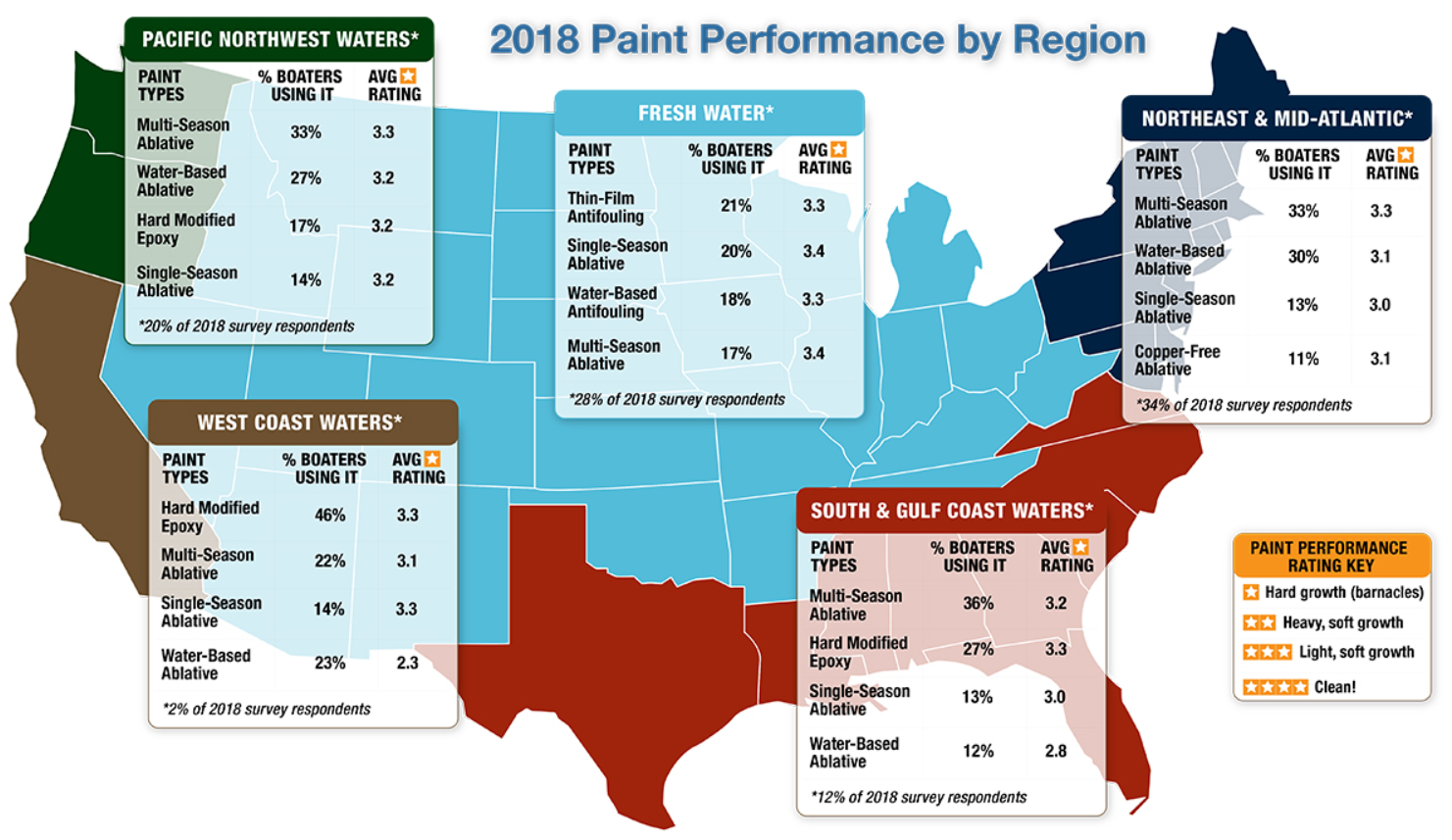
    In case you aren't familiar with Practical Sailor's [continental US] regional bottom paint testing results, here is a representative article that may be useful. (Scroll to bottom to see extensive rating tables...)

    Jamestown Distributors [JD] also conducted bottom paint surveys for several years in a row, and I found this recap article in case it is of interest.

    Following are a couple of informative graphics from the JD article linked above:


    I couldn't find their live Google map, but I remember you could drill-in and read individual submissions, so asking JD for access may prove useful if you are interested in what boaters reported using (and their ratings) in specific regions of the world.


    I recall using a hard, high copper bottom paint (Trinidad?) when I spent 7 years in the S Pacific tropics decades ago on a different boat. Cleaning the bottom monthly was good exercise...


    More FWIW info.

    June 23, 2020

    Exterior Canvas Replacement Project- Lists


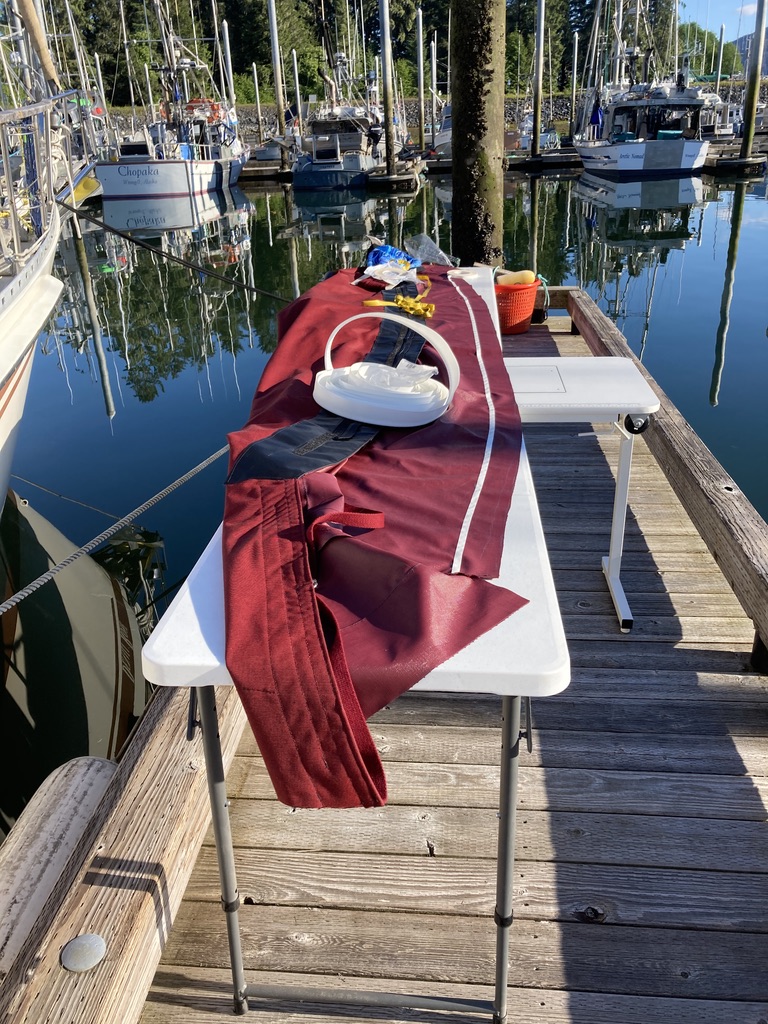
    Time to do the less than funny, more technical details of the dodger/bimini, cockpit enclosure re-do. Our older canvas enclosure was made in Trinidad in 2007, and had never been taken off. This means it was on for 13years, and some of it was well used, ready to be replaced, and other parts of it were as nice as the day it was put up. We made some of our design, and material choices based on this longevity. I've listed supplies, and tools, and then I'll do a separate post for the techniques we used. Yes, we.... Bill helped quite a bit, not with the actual running of the sewing machine, but these kinds of projects are 85% discussing, discussing again, patterning, re patterning, measuring, remeasuring, laying out, taking out, fitting, refitting, altering, adjusting, and high-fiving!

    Supplies used:

    PTFE thread. PTFE thread is dirt/water repellant, fade proof, mildew/rot proof, highly resistant to abrasion, nonflammable, chemical resistant, permanent 100% UV resistant, and lifetime manufacturer warrantied. What's not to like? Well, it's $130.95 per 8oz cone, which is 1650 yds of thread. I know it's expensive, but how many times do you want to redo your stitching on your time-intensive project. Me- I never want to take it down, and restitch it. This thread fits the bill. The old canvas was obviously stitched with a Lifetime thread, it held as good as new. 

    Marine Grade Canvas, I used Sunbrella for the side curtains on the bimini, the weather cloths, and the sail covers. It's a solution dyed acrylic material that is UV, water, and mildew resistant. Sunbrella doesn't like abrasion though, so I put chafe guard where needed, it will also fray at cut ends, so it must be cut with a hot knife, or run a lighter along the edges. None of my Sunbrella edges are left bare, they are either tucked under, or are covered with seam binding, all safe from unraveling.  Marine canvas has seen many new brands come onto the market, but I decided to stay with the recognized leader in durability. 

    Seamark material is Sunbrella acrylic on one side, and color-matched PVC on the other side, this creates a waterproof laminate. Our old dodger/bimini had this on the tops, and even though the zippers were failing, and the Sunbrella side didn't look very fresh, the underside looked brand new, totally sold me on the longevity, waterproof, and ease of cleaning. If we got any mildew on the underside, I would just wipe it clean with a Clorox wipe, and done. Another great feature, is that you can cut this with regular scissors, and it doesn't fray, no hot knife, or burning edges needed. 

    Seam binding  I like to use Stamoid binding, it's a biased cut, double folded, binding made from a vinyl coated polyester fabric. This is also dirt, UV, mildew resistant, and since its vinyl, it can be cut without having frayed ends, another plus for not having to deal with the extra bulk, and hassle of turning under raw edges.

    We used Zippers that can withstand the outside application the same way that the materials can. With over 40 zippers in the dodger/bimini, I don't want to take down the enclosure to replace zippers. I used #10, Vislon, which has teeth made from plastic that are molded into the zipper tape. Since zippers aren't made in all of the odd lengths I needed, I had to buy approximate sizes, and cut them to fit. I used stainless steel zipper stops after I cut to length, and they were very easy to install.

    Webbing, Sunbrella makes a polyester acrylic webbing that is resistant to fading and matches their fabrics. 

    Seamstick is a double sided sticky basting tape, you use it before stitching, and it holds your intended seams together. It works great to hold your fabric so you can do straight seams, it also gums up your needle, bobbin, and mechanisms. They recommend that you use an alcohol swab occasionally to help remove any residue. I kept one in a baggie next to the machine, and used it constantly, if you don't, the thread will catch and break. Mostly I used 3/8" seamstick for the Seamark, and Sunbrella, but for the Makrolon windshield [more below], I used the recommended 1/2" Mylar/Kevlar basting tape.

    Shelter-rite is a material I've never used before, but the folks at Sailrite recommend it for chafe protection. It's another vinyl coated polyester fabric material, but is formulated to be flexible in high abrasion areas, with high tear strength, and water resistance. I used it on all areas that needed a chafe guard, the dinghy cover, the leading edges of the dodger/bimini, and high wear areas inside the dodger/bimini, and curtains. Bill even used it to patch a couple of wear areas on the hypalon on the dinghy. 

    HH-66 is the vinyl cement used to glue Shelter-Rite to other surfaces. I sewed it where I needed chafe protection, but this is the glue Bill used to patch the dinghy. One of the advantages of using Shelter-Rite, is if in the future we see a need, we can glue more to it,  Ex: I cut round holes for the inflation points on the dinghy, but if we decide we need a protective UV flap, we'll just glue one on.

    Window Vinyl. Strataglass is a press, polished, and coated clear window vinyl. I used 30 gauge, for the side, and aft curtains on the bimini, and I choose this weight, instead of a heavier one, because we occasional roll up the curtains, and we needed a more flexible vinyl. Strataglass has a very detailed care sheet, and if followed, the longevity and clarity are increased. This vinyl is not an inexpensive solution, I've used cheaper vinyls before, and I expect this brand to outperform less expensive brands. It comes in 54"x110" sheets and is $204.95 a sheet, I bought three, and I will be using up all of two, and have the third for a spare. 

    Makrolon is a clear, optical grade hard polycarbonate window material. It's less flexible than window vinyl, but definitely has more clarity. We bought the VR Flexible Marine in 40 gauge from Interstate Plastics for the windshield. We would have liked the 60 gauge, but the 40 can be rolled up for shipping, and the 60 can't. These come in 52"x110" sheets, and it would have been cost prohibitive to try and ship a flat sheet that size. We ordered 2 sheets of the 40 gauge, and they came rolled for $60.00 in UPS shipping.

    Pipe Flashing is manufactured to wrap around pipes that come through a roof on a house. Bill thought this might be a good solution to help waterproof the bimini, since we have four areas where standing rigging runs through it. He sealed it with Duralink 50, Super Adhesion Sealant. More details about this in the "what we did" section later.

    4.5 x 4.5 inch base; 4 inches tall...


    Snads, Snaps, Snap hooks, D rings, oh my. Snads are adhesive backed studs for snaps, no need to drill holes in your boat in order to install snaps. Snaps come in many flavors, pick which one suits the application, just make sure they're stainless steel, nickle won't hold up in the marine environment. Snap hooks, and D rings are part of the webbing assembly that provides support and tension to the dodger/bimini support structure.

    Bolt Rope tape was used to secure the bottom edge of the dodger window to the cockpit coaming, and to secure the top edge of the weather cloths to to the hand rail.

    EZ Lace is a fabric strip with lacing holes, it eliminates the need for grommets, I used it at the bottom of the weather cloths to secure them to the toe rail.

    Foam pipe insulation: Hint: Make the dodger fit tight on the frame. Before final install, put foam pipe insulation over the top tubing frame members and then install your canvas for the final time. It will be that much tighter, reduce chafe, and have fewer hard surfaces for crew to bruise themselves on...


    Tools:
    Sailrite LSZ-1, this is a heavy duty sewing machine, that is somewhat portable. It's heavy, and you don't want to be moving it around a bunch. The LSZ-1 can sew through multiple layers of canvas, leather, and sailcloth. It has what is called a "walking foot", which means the presser foot works with the feed dogs, to advance the material through as you sew. The customer service for the company is terrific, and the maintenance videos are fantastic.

    One of the most useful tools is the seam ripper. This handy tool helped me to pull apart the old canvas to make patterns, and to pull out mistakes on the new canvas. I'd like to say I didn't use it much, but I can't. I have about 5 of these blue ones, and then several others in different sizes, and styles. Purchase many, they break. 


    Water soluble marking pencils, grease pencils, and chalk pencils, all have their place, each is different in their ability to mark up patterning, canvas, vinyl, and window material. 


    Snap positioning kit. We used the already installed on Denali Rose, male part of the snap, and put new buttons on the canvas. This kit comes with a pin socket that you snap into the male part, and then you stick it through the canvas, and it marks where you need to install the button part of the snap. Easy, and accurate.


    The Press n Snap Installation tool from Sailrite makes installing snaps easy, and quick.

    I have my regular sewing scissors from Wiss, but to cut the Makrolon, I purchased Fiskars Titanium Nitride #8 shop snip from Amazon. They were difficult to hold, and they did okay, but Bill liked his heavier tin snips.


    LSZ-1 sewing machine parts: Needles, Retaining Ring Cap Springs, Scarfed Shuttle Hook, and sewing machine oil. 

    We oiled, and changed the needle every new day I re-started to sew the Makrolon. I went through five #21 diamond point needles to sew it. For the rest of the canvas I use a regular #20, which is recommended for the PTFE thread, and Sunbrella. I don't normally change the needle so often, with Sunbrella, or other fabrics, I was just being extra cautious with the polycarbonate, to keep the sewing holes down to the minimum. 

    The retaining ring cap spring, (without going into too much detail), is a piece that sits underneath the faceplate, and is part of the assembly around the bobbin, if the needle strikes it, it creates a burr on the metal, and this caused thread breakage. I've gone through five of these, mostly while sewing the Makrolon. 

    Also from a needle strike, I had to replace the scarfed shuttle hook, which is another a piece of the bobbin assembly. I can use a jewelers file to fix the burr on the striked one, and still have a spare. 

    Hot Knife Think of this tool like a hot pair of scissors that seals the edges of your polyester material so that it won't ravel. It works great on Sunbrella, but because of the vinyl backing on Seamark,  I didn't need it on that material.

    Every time I order supplies from Sailrite, I include at least one other spare piece to the LSZ-1 machine. It's not that the machine breaks down, but IF it did, I want to be able to replace, or repair, and get back to sewing. If you live in Alaska, you know that shipping can be expensive, and time consuming, and having spares on hand can keep down-time to a minimum. I've also downloaded all of the maintenance videos, so if we have a need, we have the parts, and the instructions.

    Sailrite has great customer service, and hundreds of instructional videos. They offer the videos for free, and I appreciate their knowledge, and the time commitment it takes to put them together. We've downloaded a majority of them, and store them on a hard drive. I like having them on hand, and using our data plan just once to download. 

    I bought the Seamark from Rochford Supply, Sailrite didn't have the amount I needed, and Rochford Supply had it in stock, with reasonable shipping.

    I didn't choose the least expensive, I didn't choose the most expensive either, I researched and choose the longest lasting, and the best product for our application. Your results may vary.


    Online Merchants:


    June 13, 2020

    Friday Funny 06-12/20 (Roger that, Dodger)


    You haven't heard much from me lately, I've been keeping my nose to the grindstone.
    (idiomatic, after keep, put, have, hold (one's)) used to form idioms meaning "to work hard, or focus heavily on work." 

    It's paying off, and we're seeing results, (finally, whew.) I thought the bimini would be complicated, and the dodger easy, but that turned out to be backwards.

    In between rain squalls, I laid out, and cut the dodger pieces on the dock, and sewed most of it together inside at my sewing table.The challenge turned out to be getting the windshield sewed in, and then getting the zipper pockets to line up with the stainless support bars. Everything lined up so well with the bimini, so I wasn't too concerned, but the dodger didn't go quite as well. 


    Dodger laid out for more detailing.

    This windshield is not the typical heavy duty clear vinyl you normally see on boats, or the material I've used on the curtain construction. The brand I've used for the curtains is Strataglass, and it's the recognized leader in longevity, and clarity for marine clear vinyl. The windshield is a hard polycarbonate, Makrolon [VR; Fabrication and care info], and is is more rigid than the vinyl. My sewing machine is heavy duty, and is built to handle these kinds of jobs, but it balked at this until the engineer, (Bill), watched all of the maintenance videos, and did some work on the machine. I'm grateful that he likes that kind of stuff. Once we got the machine back in working order, it only took about twenty minutes to sew the perimeter of the window, and and the dodger is on! 

    We're also grateful for our gracious neighbor on Twinkle [thanks Judge!] who allowed us to sew out of the rain on his back deck. No way were we going to get this rigid 10ft section of windshield down into the dinette area, maneuver it around, and get it sewed into the dodger material.


    First fitting, without windshield in yet. Never mind the pressure washer in the foreground.


    Twinkle


    Set up on the back deck.


    Bill working on my Sailrite machine.
    We always tell Gus to get back on his own boat when he wanders down the dock too far, he mostly complies. While we were over on Twinkle, he spent the whole time keeping an eye on us, and loudly telling us to "get back on your own boat!"


    Gus keeping watch from the cooler.

    We finally installed the dodger for fitting, we didn't take the protective plastic off as we tweaked, stretched, and fitted it to the frame, just in case we needed to take it down again for alterations.

    In place.
    Gus has to do his job as Chief Quality Control Officer.

    He approves.

    Gus also had to approve the dinghy cover, I thought it was done until Bill pointed out that I had forgotten to put the slits in the canvas to install the center bench seat. Oops.... so off it must come for some adjustments.

    This is nice....

    We finished our tweaking, and did the great reveal!


    We love the clarity we have now!


    We still have the connector window between the dodger, and bimini to do, and that will be made with the Makrolon also,  and bottom snaps to stretch things further, so we've left our awning up for now.

    Gus loves to sit under the awning, he's outside watching the goings on, and sheltered. He'll be bummed when it comes down.

    Here is a post listing all the materlials we uses, why we chose them, and links to sources.

    As always, we enjoy hearing from you, either here in comments or on our Facebook Denali Rose Sailboat page.


    May 10, 2019

    Tidbit: Fresh water as coolant for air conditioning and refrigeration systems

    This is one of a series of brief, no nonsense posts that we call aTidbit:
    noun; small and [possibly] particularly interesting item of gossip or information...
    The purpose is to share succinct posts about lessons learned, or things we use or do that work [or don't...] that are common to most of us boaters. 
    Our goal is to garner feedback from those of you having first-hand experience with a different approach/ solution/ product/ or additional useful information to share...  
    We never assume what we are sharing is the ideal or only; it just seems to best suit our needs [and/or habits and/or budget] from our experiences thus far...

                                   ➛ ➛ Peruse the right-hand sidebar for the up-to-date list of Tidbits ➛ ➛                               

    Many boats have pump driven raw water cooling loops for air conditioners [A/C] and refrigeration systems. 

    Water cooling is required on the A/C units when the compressor is runing for either cooling or heating [e.g., reverse cycle heating.] 

    Water cooling also boosts the DC powered refrigeration system efficiency [beyond the electric fan most have...] when ambient temps in the compressor location exceed 90°F.

    Our 3 air conditioners serve two functions: cooling and heating [using either reverse-cycle heat or resistance coils.] We often use the A/Cs for heat when at the dock in cooler weather. [We are currently at 56°N in SE Alaska.] 

    Why use electricity?  Where we are, electricity costs about the same as the amount of diesel we would burn if we used our Espar heater, and this way it keeps the hours off the Espar...

    We are lucky in that the Pacific waters usually stay warm enough for reverse-cycle heat to work well. [Water temps needs to be above ~42°F for reverse cycle heat to work well...] Therefore our A/C units also have resistance heat coils as a back-up. [i.e., just like a portable electric heater...] But resistance heating is not as efficient and requires more electricity to produce the same amount of heat as reverse cycle does, so if using electric heat, we prefer running reverse cycle on the A/C compressors...

    However, since we also enjoy venturing to higher latitudes with even cooler water temps, we experimented with using a potable water tank for the cooling water loops because the water in those tanks [even though they sit low in the hull...] averages 10-20°F warmer than the water we are floating in; Perfect for using reverse cycle heat in colder waters...

    This approach of is not new or unique: The previous owner of our boat did just this with one of the refrigeration water cooling loops. Great idea. Lets extend this to the air conditioners/ heat pumps...

    For a couple of years now we have been using one of the boat's potable water tanks for all the cooling water loops— instead of raw water. [Our two potable water tanks— 110 gallons each— are low in the hull, but stay warm enough for efficient reverse-cycle heat— even in freezing water.] We dedicated one tank to this use. It is also still a back-up potable tank if needed...

    The cooling plumbing can be easily switched back to raw water again if needed via 3-way valves. [We never intend to switch back to raw water, but can if necessary...] If we switched back and forth, we would have to clean and sanitizing the raw water loop[s] before switching back to potable... [More below...]
    We should mention all our drinking water runs through a .5µ filter...
    The advantages of using fresh water in cooling loops include:
    • Greatly reduced maintenance [eliminated really...] on the cooling water pumps and loops with consequent longer lifespan of those components [fresh vs. salt water]
    • Fewer open through-hull valves
    • Reverse-cycle heat [more efficient than resistance heat] works when it otherwise wouldn't when in cooler raw water temperatures
    Some disadvantages are:
    • Coolant loops that were initially used with raw water need to be hyper cleaned/sanitized before switching to potable water [if the dedicated tank is also a back-up potable tank...]
      • If installing new there is no problem connecting to potable water tankage...
    • The potable tank used for these coolant loops is now 'emergency' only back-up for potable water— or we need to remember to turn off the refrigeration water cooling loop, and not use the A/C heat pump[s] 
      • We placed a check list next to water tank selector valve as a reminder
    To keep the water fresh in this potable water tank used for recirculating cooling water, we routinely pull water from, and immediately refresh this tank when doing laundry while running the watermaker or when at a dock.

    This set-up works well for us, and has the added benefit of saving kind souls everywhere from feeling compelled to urgently inform us our bilge pump is running continuously... [Our raw water cooling discharge is above the waterline...]

    Can you think of other advantages or disadvantages to this approach?  It has been working well on our boat for years...


    Related Posts and Resources: