Showing posts with label Conveniences. Show all posts

January 22, 2024

Tidbit: Pilot Berth in the Pilot House?

This is one of a series of brief, no nonsense posts that we call a Tidbit:

noun; small and [possibly] particularly interesting items of gossip or information...
The purpose is to share succinct posts about lessons learned, or things we use or do that work [or don't...] that are common to many of us boaters. 

The goal is to garner feedback from those of you having first-hand experience with a better approach/ solution/ product...  
We never assume what we are sharing is the ideal or only; it just seems to best suit our needs [and/or habits and/or budget] from our experiences thus far...
Sometimes these Tidbits originate from a topic of discussion on one of the forums we participate in, and this happens to be one: Link to original post [22-Jan-2024]

Since we encounter this question on occasion, it made sense to post a more detailed response for future reference.

                               ➛ ➛ Peruse the right-hand sidebar for the up-to-date list of Tidbits ➛ ➛                               


Alternate title: Sleeping around a Centre Saloon table


I haven’t had a dedicated pilot berth for a couple of boats now. [Last was the Valiant Esprit 37; Bob Perry design.] I really liked that typical pilot berth. [A snug tube that would contain you in a rollover- although likely bruised and soggy afterwards.]

What do we use for a pilot/ anchor watch berth in our center cockpit, center cabin Nauticat? 

In the pilothouse, we have U-shaped seating surrounding 3 sides of a sliding, expandable [leaf] table which is mounted on a cabinet pedestal. 

The longer [hull] side makes an excellent pilot/ anchor watch berth. [Though very rarely needed…] Do a sit up and see all instruments, MFD, etc. as well as look out the pilothouse windows, and with quick access to both helms.
We are fortunate to have a second helm station in the pilot house so we don’t have to sleep in our foulies when standing the rare anchor watch. [Think of it as a nautical contribution towards aging-in-place…]


A lee cloth is permanently attached to the cabinetry under the bottom cushions parallel to- and the length of- the table. 

It is easily deployed by lacing a line between grommets along the top of lee cloth and strong eyes installed under the table top.

When a lee cloth isn’t really needed [which is our typical scenario] we instead remove the wedge shaped back cushions from the long part of the settee [against the hull] and drop them upside down [thick edge up] into the gap between the seat and cabinet- effectively widening the berth and filling the chasm most might prefer not to discover while sleeping.

It may be worth noting that this berth has been renamed by some landlubber guests in the past who didn’t study-up on their nautical jargon before visiting [as we do recommend on our Guest Page.] Typically this happens when our overnight guest count exceeds the number of available guest berths [very rare as we can sleep 8 without becoming overly friendly]  and occasionally when guests- who normally share sleeping accommodations- decide [not always mutually] not to [for reasons unknown to us.]

Our other dog house offers very remote [and very basic] accommodation, but also include something unique: a guest selectable degree of separation [length of dinghy painter…]

Both are great locations for a nap, too [weather pending…] And either could be used while underway! [Again, Wx pending…]

_________________________________

Related Posts:

Sleeping well at anchor


March 10, 2023

Cleaning; Treating; Sanitizing; Corrosion, Mold & Odor Control [Updated Nov-2025]

With preparations for an upcoming season of boating beginning for many, we are publishing our updated, extensive list of tried and true products (as described in the title) we use and highly recommend in case you find it helpful. 

★ Some excellent recent additions/ discoveries of note are flagged with a red star.

Please let us know of any products you use that you feel we should try.


  ➛ 
➛ From our list of Stuff we have and use [and do...] in the right sidebar ➛ ➛   


Following are the products we keep onboard, and what we use them for. 

The selection comes from many years of reading hints from others as well as buying and trying many of the touted and recommended assortments of lotions and potions at one time or another. 

Categories include: [in order presented]

★ =  Recent additions/ updates
  • ★ Microfiber towel rolls [washable; saves 60+% paper towel usage...]
  • Odor Control/ Removal
  • ★ Cleaning/ Degreasing/ Stain Removal
  • Sanitizing
  • Laundry
  • Toilets, Shower Sumps and Sink Drains 
    • Holding Tanks
      • Bilge
      • ★ Sunbrella [canvas]
      • Ropes/Lines [cleaning; treat to reduce water retention and help prevent freezing in winter]
      • ★ Mold, Algae, and Mildew Control [Also: Keep your deck from turning green...]
        • Descaling
          • Corrosion Prevention/Removal
            • Bronze [and Brass...] Cleaning and Polishing


            Before continuing on this page, take a few minutes to read this excellent article from Practical Sailor . It helped us to better understand what cleaners to use for what, and how to make our own formulations to beat 'boat tax' pricing on some commonly used potions...

            We have reduced our inventory to the following few products that seem to work the best for us [and are economic, low toxicity and volatility (where possible), and readily available...]


            We carry concentrates when available and cost-effective. [e.g., 1 Gallon of bleach concentrate makes up to 100 gallons of household bleach when diluted with water, but is very caustic if spilled... Likewise for vinegar and others as noted, below.]


            A wise precaution is to read and download [you may not have internet access when you need the information...] all the Safety Data Sheets [SDS] about each product you keep onboard. It is useful when questions about the product arise, and in case there is an accident. 

            What are your favorite products? Please also leave a comment if you have used what we list below and have found something better, or have suggested additions.


            ––––––––––––


            ★ Microfiber towel rolls [for use with cleaners and polishers listed below; washable; saves 60+% paper towel usage...]

            Odor Control/ Removal

            Cleaning/ Degreasing/ Stain Removal

            • ★ Someone To Do It [Cream Cleaner] This is a 'Where have you been all my life' find! [Thank you Robin!] This is the absolute best hull, etc. cleaning product. The only product we have found that easily and completely removes diesel exhaust stains from our AwlGrip painted hull. It reduces the number cleaning products we keep on board, and is cheap!
            • Super Clean [The best we have found so far for removing most diesel exhaust stains (soot) from the hull... A good degreaser (think BBQ...) and nonskid cleaner; avoid breathing overspray... (consequently we mainly use outdoors)]
            • Krud Kutter is a great water based cleaner/degreaser for routine cleaning. [No volatile fumes from solvents- but is still smells a little funky to us... ] 
            • Oil Eater [The absolute best stuff for cleaning up oil spills on the boat, and cheap! Although the WD40 Specialist water based Degreaser (further below) is giving it a challenge...]
              • Dawn liquid dish detergent [We wish they had an unscented version...]
              • White Vinegar [Grocery store vinegar is 3% acetic acid. You can buy concentrated versions...] to reduce storage requirements by making your own batches of 3% by adding water. e.g., 30% Vinegar; [This is non-consumable garden grade vinegar]
              • Concentrated bleach [Not the grocery store variety... 1 gallon can dilute to make 100 gallons of grocery store bleach.... good for cleaning stubborn deck stains, mold and mildew on non-fabrics, etc. Very caustic! Store carefully...]
              • Stains on fiberglass:
              • Baking Soda
              • Starbrite Rust and Stain Remover [Safely and easily removes rust stains from our AwlGrip painted hull and deck]
              • ★ WD40 Specialist [water based] Degreaser and Cleaner [Excellent water based degreaser; can therefore be mailed USPS]
                • Available as water soluble pods so we can make it as strong or weak as needed.
                • Think engine room, degreasing winches when servicing, etc.

                Sanitizing
                • White vinegar [See concentrated vinegar info under Cleaning/Degreasing, above]
                • Neutra Sul HP41N Professional Grade Oxidizer [shelf stable 7% hydrogen peroxide] 
                  • For treating previously treated potable water for hydrogen sulfide odors and iron contamination.
                  • Also removes vestiges of bleach after sanitizing with bleach. 
                  • Manufacturer information
                • Bleach [We carry a concentrate that makes 50-100+ gallons from 1 gallon...]
                  • 1 tsp of 5.25% sodium hypochlorite [unscented household bleach] in 50 gallons of water yields ~ 2ppm [the minimum concentration for sanitizing...]
                  • We use up to 6ppm in potable water for sanitizing water ,tanks, and plumbing.
                  • Practical Sailor article with detailed instructions for sanitizing water systems.
                • Sporicidin [Removes mold, stains, and odors; bacteriostatic for 6 months. Used in hospitals. Available in concentrate. Look for unscented.]

                Laundry

                • Oxyclean [we prefer unscented; use with your detergent of choice- also add borax for strong odor removal] 
                  • Also good for other cleaning chores- including sails...
                  • Add ~1/2 tsp to composting toilet urine jug to eliminate odors and scale
                • Detergent of choice [we use HE non-scented detergent with our front-loading washer]
                • White Vinegar [see info above about concentrate; dilute to use against certain odors]
                • Ammonia [Great in super greasy loads... Don't use on wool!]
                • Pre-stain treatment: Shout and/or Resolve Stick [Oxyclean also makes a pre-stain treatment]  

                Toilets, Shower Sumps and Sink Drains 
                • Raritan CP [Bio-enzymatic toilet cleaner; shop around as pricing varies]
                  • Keeps the shower sump and sink drains crud free too... [And clears plugged drains...]

                Holding Tanks
                • Marine Digest It  Enzyme [Excellent for dissolving soap scum, clogs, liquifying contents, and eliminating odors. Use regularly per instructions. 1 qt bottle lasts us 6+ months. Safe for pets.]
                Bilge

                Sunbrella

                Ropes/Lines
                • Cleaning [See this Practical Sailor how-to] 
                  • We achieve good results using our unscented HD plant based laundry detergent, above
                  • We also treat with Wet & Forget to arrest green growth over time [algae, mildew, etc.]
                    • See Mold and Mildew Prevention, below
                • Conditioning; Improve water resistance and instill freeze proofing [for winter boating]

                Mold and Mildew Control and Prevention

                Removing stains:
                Prevention:
                • ★ Best ever treatment for keeping algae and mildew [green] off the deck, out of lines, canvas, sails, etc.  Wet & Forget concentrate.  [Thank you Mellisa and Mike! We apply this each fall and never have any green develop on our deck, lines, sails, etc. Safe for pets. Cheap. This stuff really works!!]
                • ★ RMR Brands Complete Mold Killer & Stain Remover Bundle [Excellent results!] 
                  • Two different liquids: Disinfectant and Mold and Mildew remover
                  • Available cheaply in gallons
                • Long term, economical, non-volatile and non-toxic control: Concrobium Mold Control 
                • SunPac mildewcide and mold inhibitor [For uninhabited spaces. e.g., long term mildew prevention in boat, vehicle, camper, etc. when away for extended periods. Area must be ventilated with fresh air before occupying. [Paraformaldehyde has no detable odor, so leave yourself a note in the treated space...]
                Related Resources:

                Descaling

                Corrosion Prevention/Removal
                • Rust Prevention:
                  • Tools and spare parts: 
                    • ZeRust products of choice
                    • We use a lot of the ZeRust drawer liner for lining tool boxes and wrapping spare parts before shrink wrapping and/or vacuum bagging
                    • Corrosion-X
                      • We even spray our bronze through-hull valves, raw water strainers, etc. to keep them pristine [not green...] Results last for years.
                • Rust removal: 
                • Loosening frozen fasteners:  e.g., loosening stainless steel bolts stuck in aluminum; rusty engine bolts, etc.
                  • PB Blaster
                  • Weasel Piss [50% acetone and 50% ATF (automatic transmission fluid) Works really well...]
                • Corrosion and seizing prevention: 
                  • Lanocote
                    • e.g., electrical connections; rigging turnbuckle threads; SS fastener threads, etc.
                  • Tef-Gel
                    • e.g., SS Fasteners- especially SS used with aluminum
                Bronze [and Brass...] Cleaning and Polishing
                  • Five proven home brews [Practical Sailor]  
                  • Slice a lemon in half; salt it; rub on bronze to remove green tarnish...

                  February 22, 2023

                  Boarding Ladder Considerations [Updated Jul-2023]

                  This is another in the series of Stuff we have and use and do...        (See right hand column =>)

                  It may not be of interest to many of you for various reasons. (Lucky you. So go count your blessings and read no further...)

                  This is more related to the higher latitudes we frequent, with the associated cooler waters...  (Or for anyone who becomes separated from the boat while underweigh...) 

                  We fully realize- and have personally experienced- regions of the world where one may never wish to get out of the water... This blurb is for those of us who must, for whatever reason(s).

                  We routinely examine the following questions when on our own boat: 

                  • While at anchor:
                    • How do we get back aboard our vessel from another craft (e.g., SUP, kayak, dinghy, etc.) 
                    • How about if we are in the water? (Intentionally or otherwise...)
                  • Our boat's freeboard is too high to pull ourselves back onto the boat.  
                    • Are our ladders usable and always available? 
                      • If not, are they readily deployable by someone in the water?
                  • When deployed, does a ladder extend far enough below the water surface to facilitate easy use?  (If the first rung is at water level you need to try it before depending upon it...) 
                    • How about if wearing diving gear? 
                    • Or folks not in the best of shape, or slightly injured? 
                  • What if someone in the water is injured? (But can still climb a ladder...)  
                    • Retrieving an injured person who cannot rescue themselves from the water is a different topic.
                  • How about at the dock? (Any dock...) 
                    • Just as you note the locations of fire extinguishers and escape routes when visiting another boat, you also take note of any boarding ladder locations, life rings, and fire extinguishers at all docks, right? 
                      • No, or none existent? Then best make sure your own boat has provisions to readily get back aboard...
                  Our home port slip is too high above water level to easily pull ourselves onto. (Especially without getting a belly full of splinters, or road rash...) 
                  Additionally, our harbor's ladders are a 200-300 yard swim for those moored near the ends of the floats. This is because there is only one ladder per fairway (Must be a legal/ insurance minimum?) And those ladders are round runged, center poled designs, so your numb, slippery feet-now bloodied after kicking off the thick layer of muscles- would try to slide off the ends of the short rungs, reaking havoc on your ankles and legs. But better than nothing...?
                  Since we do enough stupid stuff every year (without even trying...) to inadvertantly qualify for multiple Darwin awards- in different catagories even-  we strive (whenever possible) to avoid competing unnececessarily. (And besides, since our progeny fledged long ago- as did their's- it is way too late to stop our contributions to the gene pool...)

                  Therefore we do give some thought (and practice) to reboarding our boat from other floating objects- and of course the water. (Not to mention other tricky maneuvers- whether warranted or not...)

                  Our re-boarding ladders are extremely basic- if not ineligant- but also very sturdy and practical.
                  Speaking of basic: several boats ago, when I was much older and still semi-immortal, I had one of those collapsing rope ladders with hard rungs. I kept it hung over the side with a line hanging so I could yank it down into the water if needed. What a pain those are to climb, but again; better than nothing... perhaps... 

                  Back to the present. On our current boat, we made sure the welded, folding stainless steel ladder permanently attached to our stern can be easily deployed by someone in the water. 

                  Here is our very basic stern boarding ladder with 3 rungs underwater when deployed (unfolded so it extends below the water surface.) Note: Four underwater rungs might be better for SCUBA divers- and perhaps those of us with a higher than normal surface area to volume ratio...)


                  The next photo is what it looks like in the stowed position.
                  Note it is designed so it can still be used undeployed. (e.g., For accessing the dinghy, etc.)

                  Also note the sturdy stair treads thru-bolted to tabs welded to the stainless tubing rungs. These are much preferred to round tubing...


                  The [whiteish] trip-line that runs up from the wire bale (simple latch that holds the ladder in folded position, upper right, above) c
                  an be yanked from either side of the ladder by someone in the water. Pulling the trip line lifts the latch, resulting in gravity deployment of the swinging part of the ladder (the underwater portion.) 
                  Note to selves: keep fingers, toes, noses, and any other dangly bits well clear of the ladder hinges- and noggins out of fall path- when deploying from the water... (i.e., Make sure everyone is off to either side of the ladder before deploying.


                  How easy is it to access the aft deck from the boarding ladder? Our wood railing has a hinged gate in the middle of the transom to make it an easy walk-through. 

                  In the following image, I am standing on the ladder using my toe to lift the latch to deploy the lower portion of the ladder. (A boat hook would be safer, but less acrobatic...)  


                  Following is a photo of our midship boarding ladder: a folding, portable model which can be deployed anywhere along the toe rails on either side of the boat. 

                  Here it is shown deployed at the starboard midship lifeline gate. (The top wood rail is also hinged at this point- as in the above transom photo.)


                  This ladder has pins through the toe rail to secure it in place, as well as a criuser's safety line (since this ladder doesn't float...)

                  Also notice this portable ladder has stand-offs that bear against the hull.
                  Hint: Use crutch tips for this purpose. They are much sturdier and last much longer than the usual rubber caps you find in hardware stores. They also have a metal washer sandwiched in the thick foot so the tubing cannot punch through the rubber over time- tatooing the hull... (We find them in local hardware stores for ~$5/pair...)


                  We deploy the portable boarding ladder when at anchor- offering the rare visitor easier boarding as well as facilitating loading and unloading from other floating craft (e.g., SUP, kayak, dinghy, canoe, logs, etc.)

                  These are our simple methods of making sure we can always get out of the water in a hurry- even at the dock.
                  One final safety reminder we regale ourselves with often:  Just as we treat the edge of the deck as we would a 500 foot cliff when underweigh, we always use any ladder as though we are climbing up or down from a 2nd story roof on a house (or the boat in the yard:)  
                  Facing the ladder! (NOT with our back to it!) 
                  The same applies for companionway ladders/ steep steps, etc. (For us anyway...)

                  Unless, of course, one covets one of these shirts: (Lessons learned? Time will tell...)


                  March 14, 2022

                  Tidbit: Anchor Rode Scope Calculator [Updated Mar-2024]

                  This is one of a series of brief [you hope], no nonsense posts that we call aTidbit: 
                  noun; small and [possibly] particularly interesting item of gossip or information...
                  The purpose of these Tidbits is to share succinct posts about lessons learned, or things we use or do that work [or don't...] that are common to most of us boaters.

                  The goal is to garner feedback from those of you having first-hand experience with a different approach/ solution/ product/ or additional useful information to share...  

                  We never assume what we are sharing is the ideal or only. In this case it is about the attributes the builder of our boat provided for us [and some we added...] 

                  We share this information in case there are any points of interest for others, and to solicit things you have done that we might be interested in...

                                           ➛ ➛ Peruse the right-hand sidebar for the up-to-date list of Tidbits ➛ ➛                         


                  Determining how much anchor rode to veer is easy, right? 
                  Note: In this discussion, we will ignore considerations for distancing from other vessels in crowded anchorages. This is all about determing the ideal scope for the conditions in an anchorage with adequate space to do so.
                  As an example, let say we are preparing to anchor for the night using our 99 lb. Spade primary bower on our all chain rode [and we always set a longish bridle...] 

                  Our depth sounder reads 50 ft of water. [Assuming the bottom is level.... otherwise we use the deepest depth within our anticipated swing circle...]

                  Beause of the depth, we know from experience a 4:1 scope ratio is very adequate [read we sleep well] for all but extreme conditions. [In which case we would increase scope up to a comfortable 5:1...]
                  It is worth noting that deeper water allows using less scope; shallow requires more. For example, we are very comfortable with 3:1 [or even 2.5:1] scope in 90 ft. of water with our primary bower.
                  So, 50 ft x 4:1 = Pay out 200 ft. of rode. 

                  Done.

                  Or are we? 

                  What about tidal change? [Our current playground can experience 24 ft. tidal variations.]

                  Therefore, we also need to determine the stage of tide when deploying the anchor [and calculating the scope] to determine the highest predicted tide [remembering storms can influence tidal measurements- among other things...] during our planned stay. [And the lowest tide if anchoring in water shallow enough to ground us...]

                  Most of us have tide tables built-into our chart plotters and/or apps typically displaying a nice curve— making this pretty easy to do:


                  But what if all we had were printed tide tables? [I can see you paper-only chart salts smiling...]  Do you remember how to use the Rule of Twelfths?

                  Back to our example of anchoring in 50 ft. Lets say the tide will increase another 11 ft from the time we anchor. [This is the highest tide during our planned stay...]

                  Easy; 50 + 11 = 61 ft of depth. 

                  So we should let out 61 x 4:1 = 244 ft of rode; 44 more feet that we initially figured. 

                  Done again, right?

                  Wait. Did we remember to include the height of the anchor rode [bridle in our case] fairlead above the water?

                  Ours is 5.5 ft... [Lets round to 6 ft.]

                  Okay; 50 + 11 + 6 = 67 ft.

                  Then lets refigure scope again: 67 x 5 = 268 ft [an increase of 68 ft from our original guestimate...]

                  Are we done yet?

                  Not quite... 

                  Lets also remember our depth sounder is set to read depth below our keel. Denali Rose draws 6 ft. 3 in. [we will round to 6 ft] so we also need to add this value to the depth gauge reading... [How would you know this if we didn't tell you?...]

                  Once more:

                  50 [depth reading] + 11 [predicted tidal increase] + 6 [Freeboard] + 6 [depth sounder offset] = 73 ft. effective depth during our stay at this location.

                  What is our desired rode length now?  

                  73 x 4 = 292 ft of anchor rode to achieve a 4:1 scope at highest tide during our stay.

                  Yikes! That is 92 feet more than the 200 we originally calculated in our head... [A 46% increase...]

                  If we had anchored using just 200 ft of chain, we would have ended up with a scope ratio of 2.7:1 [at the highest predicted tide during our stay...]; quite a bit less than the 4:1 ratio we prefer for this depth... [But likely adequate for calm conditions with our oversized ground tackle.]

                  So, we can still do this arithmetic in our head, right? 

                  Yes. In our [ever diminishing] attempts at staying sharp, we calculate how much chain to veer in our heads each time as we prepare to anchor.

                  To make this easier we simplify; there are two variables: depth and tide; and two constants [which become one]: freeboard + depth offset.

                  So, the simplified version is: add 12 ft. to the depth meter reading + how much higher the tide is predicted go [during our intended stay period] when we drop anchor, then multiply by our desired scope ratio, thus:

                  Staying with the current example: depth reading variable [50] + our constant freeboard and depth offset [12] + highest tidal variable during our stay [11] = maximum effective depth during our stay [73] X 4 = 292 ft of chain.


                  And lets remind ourselves, our chosen rode length is assuming a level bottom... 

                  What if you are anchoring on an incline? [Even a slight one...]
                  When figuring the angle of the rode at the anchor when the rode is under high load [i.e., is 'bar tight' or almost straight...] one only needs to measure the angle between the straight line of the rode and the slope of the seabed in the direction the anchor is set, correct? [Trick question.... more below...]

                  Yes. And the worse case angle of the rode is determined by the straight line between the anchor attachment point, and the fairlead the rode is first lead through on the boat... In your example, the bow eye [with the snubber- now part of the straight line rode...]

                  Explaination of trick question, above:

                  When anchoring, our goal is to keep the angle of the rode at the anchor attachment point smaller than the tripping angle of the anchor. [Typically under ~5° with modern anchors] We typically do this by letting out more scope in incliment conditions, but this common approach doesn't allow for a sloped bottom... [That is another discussion (on Cruiser's Forum) that is well worth reading...]


                  Image from Cruiser's Forum discussion

                  Are we having fun yet?

                  Back to where we were with our original example: 

                  We have determined we need to veer ~292 feet of rode. [Lets round-up to 300 ft.]

                  A chain counter would make this easy— especially since we gravity drop our anchor and rode. [i.e., FAST!]— but we are the chain counter... 

                  While the chain is whizing by, we need to keep track of the plastic zip ties screaming past  as well so we know how much we have veered... [Our rode is well marked with colored zip ties every 30 ft— or 5 fathoms... or even shots (15 fathoms of chain, or 90 ft) if that is how you think... ] 

                  Our marker pattern is one red ziptie @ 30'; 2 reds at 60', 3 reds @ 90'; 1 white at 120', etc. , through Blue, then Yellow... So which color, and how many are we shooting for to reach 300 ft? 
                  We are also experimenting with a 3 ft. length of yellow pollypropelene line woven into the chain links at each set of markers to aid visibility— especially during our typical high speed gravity chain deployments.  
                  So far so good... 
                  A cheat sheet can be handy for determining which set of rode markers we want. This is because our markers designate either foot [30] or fathom [5] increments— probably making the marking scheme more complicated than it need be... [I'm constantly rethinking this, but old habits... Keep reading to see why a change isn't a priority...]

                  Our chosen rode marking system [that doesn't require keeping a mental count...] helps offset my self-awareness that I can [and do...] make mental mistakes even when I'm rested and alert— let alone when I've got too much to think about when I should be concentrating on anchoring maneuvers.

                  Enter my dynamic cheat sheet. [Another way of looking at it is I'm basically very lazy, so it is easier to make a calculator; trust but verify— even one's self...]
                   
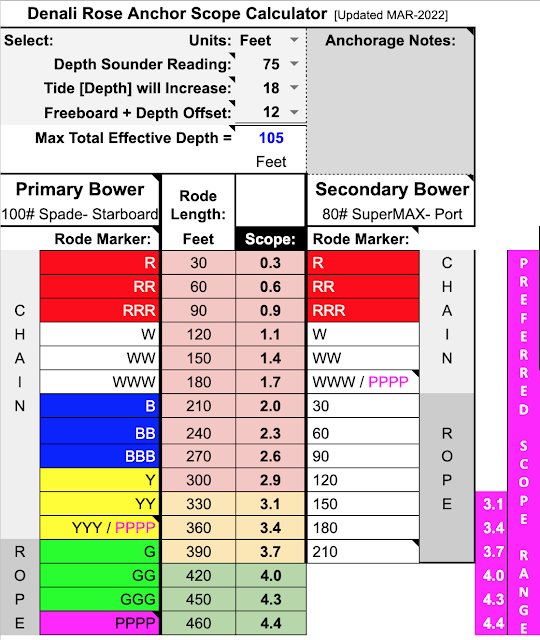
                  The following screen shot of our prototype scope calculator is displaying the example values from above :


                  After selecting the 4 variables at the top left [Units, Depth sounder reading, etc.] the Scope ratios are calculated and color coded based upon value. [See Scope Color Key in middle right, above.]

                  Find the desired ratio in the Scope column and read the required length of rode.

                  In the same row, find the Rode Marker [colored zip ties in our case] you are looking for [Note we have two anchors, but typically use the primary bower- 99lb Spade.]

                  In our example, looking at the Scope Color Key for our desired ratio range, then choosing a scope from that range from the Scope column. [Notice the hot pink Preferred Scope Range column on the right is highlighting our preferred range taken from the Scope Color Key for the calculated Effective Depth. (In this example 3-3.9:1. Lets round up to 4:1 just because we can...)]  
                  Next we slide left to the Primary Bower Rode Marker column to find we are looking for one yellow ziptie on the chain portion of the rode to achieve 4.1:1 scope for the effective depth at the highest tide during our stay; 300 feet of all chain rode. 
                  If we desire more or less rode for any reason, we can choose accordingly. 


                  The next screen shot is a close-up of the calculator itself showing a new set of variables. 

                  How much scope [and which primary bower chain marker] would you choose? [Assuming no other obstacles to consider in the anchorage...]

                  Close up of business portion of calculator showing more typical depths in our cruising areas. 

                  Note the color coding automatically shifts in the Rode Length and Scope columns to help guide weary eyes.

                  Your turn: Pretend like you are just finishing a great day of boating and [if like us...] are a bit tired and hungry [an perhaps a little dehydrated- and maybe a bit cranky...] and you are approaching your anchorage for the evening... 

                  Oh, and you are expecting some weather in the next couple of days, so don't screw it up...

                  How adept are you at calculating everything in your head now? 

                  Test yourself: 

                  Quickly calculate the rode length at 4:1-ish scope in your head for a depth sounder reading of 65 ft., consulting your tide resource for the highest tide during your stay to determine how much deeper the water well get. [Lets say 7 ft. for this example.]

                  Which chain marker [set of colored zip ties] are you shooting for? 

                  Quickly now- since you are already gravity dropping [fast releasing] the chain in anticipation of sundowners— and you just saw a pair of white zipties go by...

                  And your answer is?...

                  Here is what the calculator came up with if you want to double-check yourself:


                  How did you do?

                  Did you remember to stop short of your chosen final rode length to allow for the length of your snubber or bridle? [Our bridle adds 20-35 ft./leg depending upon how much we let out- which depends upon anticipated conditions...]

                  At this point I suspect most of you are wondering about my mental state [me too...]   

                  Do I really need to use a calculator to anchor?

                  Absolutely not! 

                  The arithmetic isn't difficult. [But building the calculator was fun- even if unnecessary...]

                  Typically I use the calculator in between the first soft anchor set [short scope] and the final hard set [which is performed after the total desired rode length is veered, and the bridle is deployed.]

                  Trust [thyself] but verify...

                  What are your methods of simplifying the hidden complexities of determining desired scope and anchor rode length?


                  Below is a link to our live calculator. Have at it... [Note: If several individuals use it at once, you may see changes being applied by others... more insanity...]

                  This prototype was developed using Google Sheets. [Yes, our verson also works when not connected to the internet...]

                  Here is the online version of our live scope calculator. You are welcome to use it online [and/or copy or download a version that runs in Google Sheets— or convert to the spreadsheet application of your choice...] 

                  Or print it out for your dart board...

                  Update 28-Mar-2024: For a calculator that takes into account all of the variables discussed above and more, it is hard to beat the Anchor Chain Calculator [app available.] 
                  Since its release [after we created our less capable version, above] it has been our go-to choice. Highly recommended.

                  It is also worth noting that a link to the Anchor Chain Calculator mentioned here was added to the list of Additional Resources shown on our calculator when it was first released [July 2022?]


                  Please comment if you discover any errors or omissions, and of course share your enhancement ideas.