Showing posts with label Refrigeration. Show all posts

May 10, 2019

Tidbit: Fresh water as coolant for air conditioning and refrigeration systems

This is one of a series of brief, no nonsense posts that we call aTidbit:
noun; small and [possibly] particularly interesting item of gossip or information...
The purpose is to share succinct posts about lessons learned, or things we use or do that work [or don't...] that are common to most of us boaters. 
Our goal is to garner feedback from those of you having first-hand experience with a different approach/ solution/ product/ or additional useful information to share...  
We never assume what we are sharing is the ideal or only; it just seems to best suit our needs [and/or habits and/or budget] from our experiences thus far...

                               ➛ ➛ Peruse the right-hand sidebar for the up-to-date list of Tidbits ➛ ➛                               

Many boats have pump driven raw water cooling loops for air conditioners [A/C] and refrigeration systems. 

Water cooling is required on the A/C units when the compressor is runing for either cooling or heating [e.g., reverse cycle heating.] 

Water cooling also boosts the DC powered refrigeration system efficiency [beyond the electric fan most have...] when ambient temps in the compressor location exceed 90°F.

Our 3 air conditioners serve two functions: cooling and heating [using either reverse-cycle heat or resistance coils.] We often use the A/Cs for heat when at the dock in cooler weather. [We are currently at 56°N in SE Alaska.] 

Why use electricity?  Where we are, electricity costs about the same as the amount of diesel we would burn if we used our Espar heater, and this way it keeps the hours off the Espar...

We are lucky in that the Pacific waters usually stay warm enough for reverse-cycle heat to work well. [Water temps needs to be above ~42°F for reverse cycle heat to work well...] Therefore our A/C units also have resistance heat coils as a back-up. [i.e., just like a portable electric heater...] But resistance heating is not as efficient and requires more electricity to produce the same amount of heat as reverse cycle does, so if using electric heat, we prefer running reverse cycle on the A/C compressors...

However, since we also enjoy venturing to higher latitudes with even cooler water temps, we experimented with using a potable water tank for the cooling water loops because the water in those tanks [even though they sit low in the hull...] averages 10-20°F warmer than the water we are floating in; Perfect for using reverse cycle heat in colder waters...

This approach of is not new or unique: The previous owner of our boat did just this with one of the refrigeration water cooling loops. Great idea. Lets extend this to the air conditioners/ heat pumps...

For a couple of years now we have been using one of the boat's potable water tanks for all the cooling water loops— instead of raw water. [Our two potable water tanks— 110 gallons each— are low in the hull, but stay warm enough for efficient reverse-cycle heat— even in freezing water.] We dedicated one tank to this use. It is also still a back-up potable tank if needed...

The cooling plumbing can be easily switched back to raw water again if needed via 3-way valves. [We never intend to switch back to raw water, but can if necessary...] If we switched back and forth, we would have to clean and sanitizing the raw water loop[s] before switching back to potable... [More below...]
We should mention all our drinking water runs through a .5µ filter...
The advantages of using fresh water in cooling loops include:
  • Greatly reduced maintenance [eliminated really...] on the cooling water pumps and loops with consequent longer lifespan of those components [fresh vs. salt water]
  • Fewer open through-hull valves
  • Reverse-cycle heat [more efficient than resistance heat] works when it otherwise wouldn't when in cooler raw water temperatures
Some disadvantages are:
  • Coolant loops that were initially used with raw water need to be hyper cleaned/sanitized before switching to potable water [if the dedicated tank is also a back-up potable tank...]
    • If installing new there is no problem connecting to potable water tankage...
  • The potable tank used for these coolant loops is now 'emergency' only back-up for potable water— or we need to remember to turn off the refrigeration water cooling loop, and not use the A/C heat pump[s] 
    • We placed a check list next to water tank selector valve as a reminder
To keep the water fresh in this potable water tank used for recirculating cooling water, we routinely pull water from, and immediately refresh this tank when doing laundry while running the watermaker or when at a dock.

This set-up works well for us, and has the added benefit of saving kind souls everywhere from feeling compelled to urgently inform us our bilge pump is running continuously... [Our raw water cooling discharge is above the waterline...]

Can you think of other advantages or disadvantages to this approach?  It has been working well on our boat for years...


Related Posts and Resources:

March 24, 2017

Friday Funny 03/24 (Refrigeration)


Whew...

Is refrigerator cleaning a part of your spring cleaning? We have to do it routinely, or who knows what science experiments will actually begin to move on their own. Maybe we could employ Mr. Death to clean out the deceased items on a regular basis.

Snidely Milk Lash

We have choices for refrigeration on Denali Rose. We have the usual in-counter (deep dive) fridge, which we try to keep organized with small crates.


Well organized.

Not so well organized. I do know that the cheese bin is on the bottom.

We were keeping our leftovers in hard sided containers, but we found they took up too much room, and switched to zip-lock bags.


Various sizes of this, you use the pump tool to pump out the air after you seal the container.

Various sizes of zip-locks, I made the holder, and it hangs on the wall above the counter.

We also have a sharpie pen close by to label the bag. Items inside these bags can quickly become those "dead things" if you don't know what it is, or when you put it there.

We also have a front door fridge that is mounted under the countertop.


Also with organizational bins.

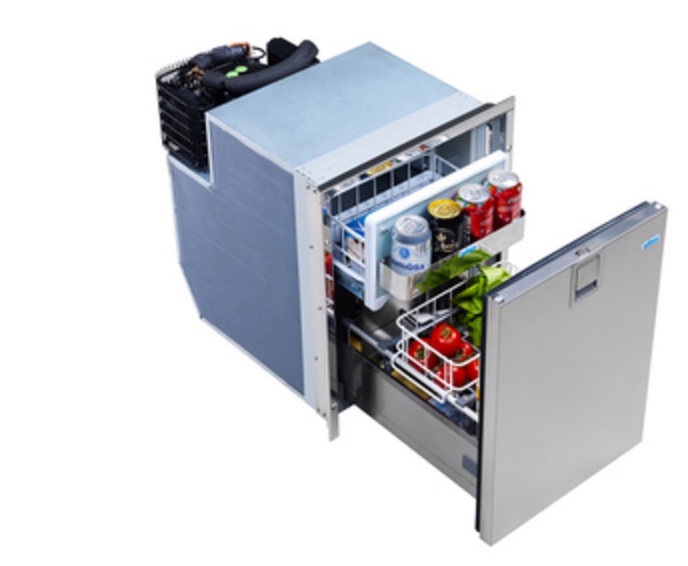
This unit is very old, eats power, and I have to get on my knees to see in, and pull items out. I'm dreaming of a new drawer model to fit in here.

My dream fridge.

We would already have installed one of these except for one problem.

The aft side of the galley.

The current fridge is in the lower left, and it is 23 inches wide. The width between the handrail on the left [in the above photo] and the mast on the right is 19 inches. Soooo, it's either dismantle a wall, or pull the mast off of the boat to get the old one out, and the new one in. [This predicament is also why our stove has an oven almost tall enough for a pie...] Neither of those options will be happening anytime soon, so for now we will use what we have.

We also have a dedicated freezer, it's the size of a large cooler, and it holds quite a lot. We need to eat up what's in there now, so we can make room for all of the fish we intend to catch. (Wishful thinking, please send positive vibes.)

The aft side of the lower dinette.

The Engel freezer inside the bench seat.

Organized meats, but no room for ice cream. Alas!

We turned off the heater to the v-berth, and closed the door. This action created another cool storage room, so we put large refrigerator items in there on the port side upper bunk. It has worked out great, but just today, it's getting too warm, (finally), and almost everything got moved out.

Fruit, onions, veggies, yogurt, and pickles were stored up there.

Maybe......   

Clearing off the countertop, always need more space.

What is on your spring cleaning list? Do you have more than one fridge to clean? Let us know here in comments, or on our Facebook Denali Rose Sailboat page.


July 31, 2016

Refrigerators and Freezers on a boat...?

We are sometimes asked by our landlubber friends [especially those planning a visit...] how we keep 'fresh' foods on our boat [they are thinking ice cream... and beer...] And by fellow boaters how much and what type of refrigeration we have onboard... [They are often thinking how do we preserve our fresh catch of the day... and beer...]

Well, our boat came with 2 refrigerators and one freezer. We also have 3 coolers [2 of which are a very efficient- meaning overpriced... brand.] The 3rd cooler is mounted on the aft deck and suits a double purpose as a seat- and is full of spare and dock lines for some reason...
For perspective, this reference is for 2 full time live aboard adults- one (your's truly) with a hearty appetite. We typically have a chance to shop in a store every 2-6 weeks- not including anything we harvest [fish, colds, etc...] 
By now you may have surmised we are definitely not vegetarians.... Only well heeled in Alaska can afford to be dedicated herbivores... Up here, when you are asked to bring a salad to the pot luck, you need to explore why you are on the fecal roster... 
Besides, salad is what food eats... 
But I digress...
The main fridge is a top loader built into the boat originally, and is roughly 9 cubic feet in size. 

It is a refrigerator only [no freezer...] and is cooled by a modern 12VDC air or water cooled [user selectable] refrigeration system and is pretty efficient. [More in related forum discussion at end of this post for those interested...] 

The top loader easily handles our refrigeration requirements  for several weeks at a time. [Two omnivorous adults with carnivorous predilections...]
We also keep a few heads of cabbage against the hull, and grow sprouts [we use our 25+ year old Biosta sprouter...] for crunchy green stuff after the fresh stuff runs out- or converts back to humus in the refrigerator... 
Delicate greens don't seem to do well being tossed around- even under refrigeration- on a routine basis... Not to mention they are typically near the end of their appeal by the time they reach Alaska, let alone by the time we acquire them...  
Either that, or they won't ripen for weeks after acquisition... [This might help explain why the Admiral- who was born and raised in Alaska- thinks green bananas are ripe... and throws away those rotten, yellow bananas... Therefore I cannot in good conscience recommend her banana bread despite her otherwise excellent baking skills... Don't worry; I won't get in trouble for this... she knows... deep down...]
Does anyone remember the eating scene from Soylent Green? [It could have been filmed in our pilothouse a few weeks after the last provisioning run...]
But I digress... [Again...]
Being a top loader, it invokes angst in anyone desiring something stowed below the top layer- which is always where what you desire is located... [We use stacking baskets, but still envy front/side loaders... For those at home, it is akin to your chest freezer... What you want is always at the bottom, isn't it?]
Here is a good article about organizing a top loader by Carolyn at the Boat Galley.
The 2nd refrigerator is an old [ç1980s] Norcold front loader [AC/DC; 4 cubic feet?] under counter fridge. It has the token small freezer compartment on top which usually keeps our fish bait preserved well enough to reduce associated odors and subsequently the number of sideward glances at the galley slave for the day... 


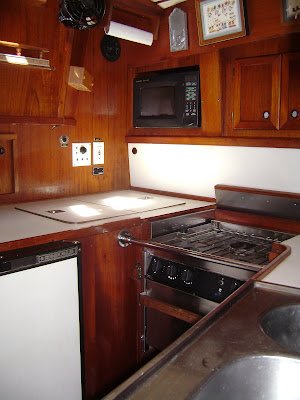
You can see the top loading refrigerator hatches in the counter top left of the stove, and the white door of the Norcold [lower left corner...] And yup, that is a microwave in the upper middle of the photo...

The old Norcold is inefficient [energy-wise] by today's standards and is therefore slated for replacement someday... [...sometime when the main mast is removed due to its size and location...]

We typically only use it when we have guests aboard, and in warmer weather sometimes to pre-cool drinks, etc. when we have extra electricity [e.g., when motoring or when the generator is running...] Even when using the extra capacity with guests, we typically shut it down overnight due to its excessive power consumption... 

The 3rd is a Engel chest type AC/DC [and by that I mean electrical preference...] chest cooler secured under a lower settee bench and used exclusively as our freezer. [84 quarts] We use this full time to store proteins for our consumption [and the occasional bit of ice cream or blue berries...] Engels are very efficient energy wise, and it quickly freezes our catch of the day maintaining the fresh quality of the protein...

We vacuum bag everything stored in the freezer [i.e, no styrofoam trays from market packaged meats- and the market will often do that for you if asked in advance...] and stack it vertically [with hand written labels on the bag tops- like file folders...] so it is quick and easy to pull what you need. [Slip items to be frozen between two frozen items and it quick freezes quite nicely...] 

We also keep a couple 'blue ice' type of cold blocks in the freezer for picnics  and for putting in main fridge to offset heat when bulk loading during provisioning, self defense, etc.

Perhaps worth mentioning is another refrigerator inherent with boating in cooler waters: stowing items against the hull [Yes, landlubbers, on the inside of the boat...] We routinely store a variety of items this way with great success. e.g. Beer, wine, vacuum wrapped hard, aged [4 yr+] cheeses, a few heads of cabbage, potatoes, onions [and no, the produce is not as well aged as the cheese nor wine, but sometimes ends up looking the part...]

As you can see, in this lifestyle we suffer greatly... and so will you when you visit...

Of course, many cruisers get by famously without any refrigeration, as did human kind until fairly recently... [Historically speaking... ] 

Meanwhile, others cannot get by without an ice maker. [Nature is our ice maker; on a prior boat, I relied solely on glacial ice for over a decade...] However, should we ever venture to warmer climes again, an ice maker might just gain priority on our list as well...

To each their own...


What are your choices, and why?


Also check out this more recent post about our galley [with photos and additional details about the refrigerators and freezer...]


Related forum discussion: 

Link to original forum post [19-Apr-2016]


Re: Water Cooled Refrigeration


Quote:
Originally Posted by Martin S 
What's your experience of using water cooled condensers. I am considering the ISOTHERM range. Currently I have an air cooled condenser it seems very inefficient and has the additional problem warms up the already warm cabin.
Replacing looks reasonably straight forward. I'd love to hear from others who have tackled this. Thanks...
Hi Martin,

The previous owner of our boat spent 15 years in the Bahamas and S America.

They replaced the main refrigerator compressor set-up to one with both fan and optional water cooling.

They installed the water recirculation pump with an on/off switch and separate hour meter, and plumbed it to one of the 2 potable water tanks to eliminate raw water cooling concerns. [The boat has 2- 110 gallon water tanks and a water maker.]

Since that compressor can be air or water cooled, and each have a separate hour meter, it was easy to quantify the efficiency gains comparing run times of water vs. air cooled [30+% based upon 2 years of data in the same region where Cooling Degree Days in the warm seasons average mid 3 figures. i.e., the higher the number, the more cooling needed to reach your desired cabin temperature. Likewise re: heating for Heating Degree Days...]

Note that the boat is also air conditioned, but that was only as needed unlike the 24/7 refrigeration demand...

Since we are in cooler climates with that boat now, I have experimented with turning on the water cooling that same system. It does reduce the run-time somewhat [4-10% on average depending; more on sunny summer days, and also in winter when we are heating the boat full time...] but perhaps not significantly enough to justify it if I was starting from scratch and planning to stay in cooler climates. That would of course change if/when we take the boat to warmer regions.

Otherwise, given how happy we are with the efficiency of our Engel freezer, I also wouldn't hesitate to install an retrofit Engel compressor in our ice box...

One last thought, depending upon the compressor you currently have, it might also be worth evaluating adding one of these newer [and intriguing] compressor optimizing devices.


Best wishes with your project.

Cheers!

Bill