Showing posts with label Lifestyle. Show all posts

March 27, 2024

Tidbit: Walkie-Talkies [GMRS Radios] for casual comms

This is one of a series of brief, no nonsense posts that we call a Tidbit:

noun; small and [possibly] particularly interesting items of gossip or information...
The purpose is to share succinct posts about lessons learned, or things we use or do that work [or don't...] that are common to many of us boaters. 

This post is also worthy for listing in our Stuff we have and use sidebar —>

The goal is to garner feedback from those of you having first-hand experience with a better approach/ solution/ product...  
We never assume what we are sharing is the ideal or only; it just seems to best suit our needs [and/or habits and/or budget] from our experiences thus far...
Sometimes these Tidbits originate from a topic of discussion on one of the forums we participate in, and this happens to be one: Link to original post [27-Mar-2024]

Since we encounter this question on occasion, it made sense to post a more detailed response for future reference.

                               ➛ ➛ Peruse the right-hand sidebar for the up-to-date list of Tidbits ➛ ➛                               


Many users [ourselves included] use hand held Marine VHF radios to maintain comms when some or all crew are off the mother ship [on land or other watercraft] in remote areas.

Sometimes these are not appropriate- especially if you need to issue radios to several different guests off exploring in different directions since other vessels in the area might also hear the conversations [and we might occupy marine channels those actually boating need to use…]

Therefore, we have always keep a few [5; lost 1 over the years] cheaper, general use GMRS radios onboard for years for the same purpose. 

They work great. 
And once [so far…] on a remote kayaking trip, these radios were of great assistance during an emergency when one of 3 of kayakers [each with their own GMRS Radio] broke their wrist [during inclement weather; e.g., It was a dark and stormy night…] because of a fall on ice while hiking alone. 
There are several Walkie-Talkie radio types available, and are well described on this forum post.
Note: Last I knew [in the US anyway] technically you need an FCC license to use the high power GMRS channels, but that may have changed.
We issue them to guests whenever they are venturing off the boat [e.g., kayaking, SUP, dinghy, or hiking on land- remote or in a town.]
For safety, we do also issue those off on their own waterborne adventures from the mothership Marine VHF radios [and PLBs] for emergency use. [e.g., As we tell visitors ‘In case the mothership is struck by a meteor while you are away…’]

Coordination with users who may not be used to using radios:

About 15 years ago, we color coded ours with a wrap of different colored electrical tape on each antenna [useful when wanting to hail someone anonymously; original tape is still going strong…]

Photo taken Mar-2024; Taped applied ~ 2008?

We have fun making up bogus call signs:  [Sounds cool and officious; Less prone to interruptions by other radio users not in your group in crowded locations- like big cities- where we would likely be using cell phones anyway…]
Charley-Alpha-Kilo-Oscar, this is Charley-Alpha-Kilo-Bravo 
[Candy-Ass Kayaker Orange (antenna tape), this is … Blue…]
For distance use when separated, our protocol is to start/ hail first on a specified low power channel (e.g., GMRS 13; 1 watt- for better battery life) then, if unsuccessful raising the other party(ies), switch to a specified high power channel (e.g., GMRS 14; 5 watts?) and try again… [This works best with a comms schedule- e.g., everyone check in every 30 mins.]


Battery considerations: 

We prefer electronics that can use the Panasonic Eneloop rechargeable batteries [AAA, AA] we standardized on almost 20 years ago [still rate among the best for low self-discharge rates; e.g., long shelf life once charged.] This is so we can issue spare batteries for the GMRS issued to those traveling a distance from the boat [just in case… There aren’t any charging stations handy when traveling by kayak, sup, or hiking in remote locations…]

Sidebar: Radios are half - duplex [only one can speak- or more accurately, be heard- at a time, and then you have to release the PTT button to listen… If you want to…] Even if VOX [voice activation] is used. This is very adequate for most of our use cases, and what VHF radio users are used to. [This paradigm is also perfect for certain couples; some have even confided they found that judicious use of their personal volume control very satisfying…]
But for ‘real time’ comms on the boat [volume up; e.g., anchoring, hauling anchor, mooring, etc.- especially in sporty conditions] we prefer full-duplex headsets [you can still hear the other person if you are talking- like a phone; no PTT (push-to-talk) button.]. Nothing missed that way…

We do recognize that some relationships claim to attribute their longevity to only one member being able to [or being the only one to ever] speak [be heard?] at a time [half-duplex; the other party remaining silent until the speaker is finished- reportedly sometimes for long periods thereafter- or has released the button on the radio in our case…] 
But there are situations when the ability to interrupt is necessary [if not sometimes risky…] hence our preference for full-duplex headsets for real-time comms during boat maneuvers… [Always with carefully modulated volume— of one’s own voice of course. After all, they didn’t nickname these headsets ‘Marriage Savers’ arbitrarily…]


Please share your experiences, choices, and recommendations. We learn something new every day…


November 10, 2023

Friday Funny 11-10/2023 (Fresh Water Falls in Salt Water Bays)


The blog has been quiet for awhile, mainly because we ventured into areas where there wasn't a cell signal for hot spot internet usage, and we haven’t jumped on the Starlink bandwagon yet. We've been exploring SE Alaska for nine years, and we still have many areas that we haven’t seen yet. This year, we cruised a few places we knew, but many that were new to us.

Though we had a fairly sunny, and warm summer, we had just enough rain to make the waterfalls spectacular.

Shrimp Bay

Two waterfalls


Enjoying a closeup kayak ride

Port Walter

A braided waterfall

Deep Cove

Before rain

After rain

Gut Bay

Many falls at once

Red Bluff Bay


Chatham Strait


Baranof Warm Springs


Seemed like it was a "Waterfall Cruise", there were usually multiples in almost every bay we were in. The scenery is usually spectacular in N. America's largest rainforest.

As always, we enjoy hearing from you, either here in comments or on our Facebook Denali Rose Sailboat page.


November 26, 2020

Happy Thanksgiving! [Rerun...]

Dear family and friends, this is a republish of our post from last year[s] this time... [at least for those of you with good recollection skills...]

And we are re-wishing you a Happy Thanksgiving! Again!

Why a reprint? Aren't you worthy of a new post?  Of course you are, but aren't these holidays pretty much the same each year?  [Even 2020; isolated is our norm...] The greetings, the menus, the company, the football games [or figure skating...], the photos, the stories, the personality disorders... [I'm not referring to you, of course...]

Need I go on...?

Therefore, being such traditionalists ourselves [not ever...] we see no choice but to repeat what we already said...

Again...

In the past I even went so far as to always wear the same sweater to family gatherings each year to honor the holiday spirit! [And incite confusion in the future; Which year is this photo from? Look at that; Bill never changes...]

Its these kinds of considerations that help make holidays timeless [or make time stand still?...] don't you think?...

And for those of you with poor or selective memories, well, ignore this intro. [Heck, some of you may already be wondering how or why you slogged through to this point anyway...] Instead, just read on to our [new to you] holiday greetings, below...

So lets get to it, shall we?

Happy Thanksgiving! [Again!]

Many of you often [repeatedly...] share the sentiment [usually with a detectable hint of sadness...] of what it must be like to live a 'camping' lifestyle afloat- especially during traditionally family-holidays...

Well, as our fellow boaters know, it is really no different than on land. [And for the rest of you, it's not really much different than living in a small, cramped older travel trailer- sometimes in a trailer court or even a coveted Wallmart parking lot...]

We shop [and/or hunt, trap, and fish] days [or weeks, or months...] ahead selecting only the finest quality trappings for the meals- which are meticulously prepared- just like in a home...

And, as holiday tradition warrants, we are always prepared for the unexpected [oft repeating] guest(s.)

In essence, we eat our hearts out, and so should you...

Our [reprinted] photo epitomizes one of my favorite lines: [from Chevy Chase's movie Vacation]
 I don't know why they call this stuff Hamburger Helper; it tastes just fine all by itself...

Wish you were here...


PS:


August 17, 2019

Friday Update, not really Funny 08-17/19

Well, I warned you about not receiving a Friday post on time. This is the first internet we've had in two weeks.

Glacier Bay was everything we knew it would be. The weather high held, and we had two weeks of blue, sunny skies, warm days, and cool nights. We ticked off the "must sees" everyday, glaciers, bears, seals, otters, and whales. We didn't always get photos, as it was nice just to live in the moment without a lens in front of the view.

Some highlights:

Inside the Huna Tribal Hall, incredible workmanship.

A Coast Guard Cutter which was inside the park, this would be handy later.

This is when the CG came in handy.

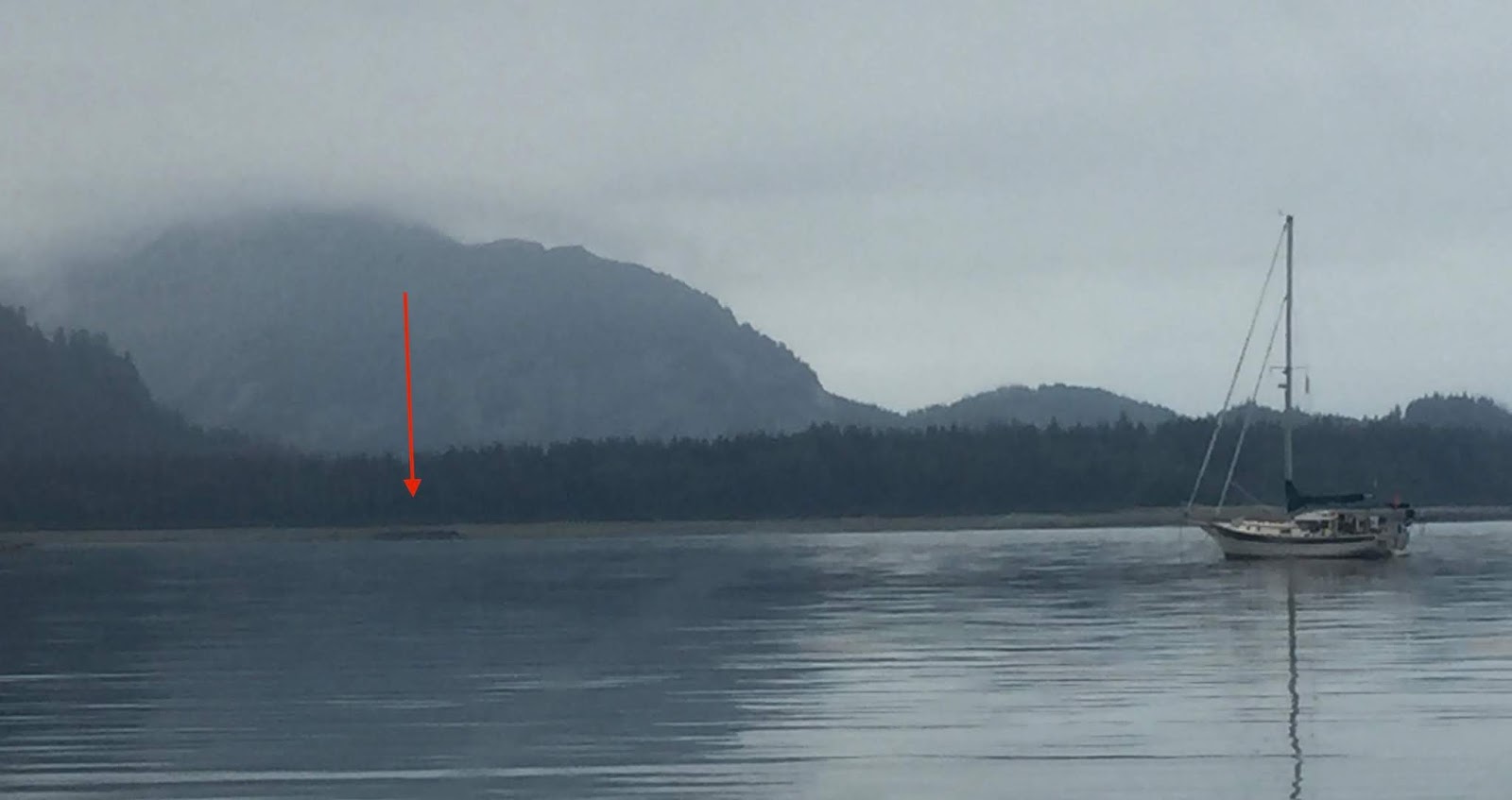
On our first night in the park, we were joined in our bay by another cruiser. See the rock that the arrow is pointing to? They unfortunately, laid their boat over on it, and we hosted them onboard until high tide at 2:00a, to see if they could float back off. No one got much sleep, and the miracle happened, they floated off without any discernible damage. It was a good, stout, well made boat, and everyone was glad for it. We did a "Pan Pan" at 10:30pm, and when the Coast Guard learned we had things in hand, they decided not to stop, and requested an update in the morning. (Pan Pan is the international standard urgency signal that someone aboard a boat uses to declare that they have a situation that is urgent, but for the time being does not pose an immediate danger to anyone's life or to the vessel itself. A sort of Heads Up everyone.)

Reid Glacier

Denali Rose at anchor behind Reid Glacier, those are "hanging glaciers" in the mountaintops.


Lamplugh Glacier

A Nat Geo cruise vessel enjoying the scenery

John Hopkins Glacier

And the one glacier everyone on any kind of ship comes to see:

Margerie Glacier

Check out the leaning face of Margerie Glacier.

We hung out in front of Margerie Glacier for about two hours, thinking perhaps we would see the face calving. That large leaning piece looked like it might fall. We didn't hear much creaking or groaning, glacier sounds, so we thought it might still be securely attached. Just as we were about fifteen minutes away, we heard CRASH, and turned around to see the splash of ice entering the water. Oh well, we tried to be at the right place, at the right time.

Check out all of the boats/ships that cruise Glacier Bay on a daily basis, we're used to solitude, or just a couple of other boats, this is kinda crowded for us. This is a snapshot of boats that use AIS, (Automatic Identification System, personal boats don't have to have this technology, some have send/receive - we do, some only receive, and some don't have it at all.)


The Park Service allows 2- large cruise ships, 4- day cruisers, usually 80-125 passengers, and 25- personal boats a day.

We explored all arms of Glacier Bay, and then left to find good shelter for the predicted upcoming storm. We're partway to Juneau tucked into Swanson Harbor tied up to a state-built float. Snug, warm, and have invited the other boat tied up here, over for "sundowners" later. Rum anyone?

and you thought I would forget the cartoon didn't you.......


As always, we enjoy hearing from you, either here in comments or on our Facebook Denali Rose Sailboat page.


May 17, 2019

Friday Funny 06-17/19 (Adult Camp)

Except we are the Moms, and we're the ones at camp.

Last weekend the BOW, (Becoming an Outdoor Women) Camp was a blast. We had about 80 women, not including the organizers, instructors, and camp staff. With my friends, we flew to Juneau, stayed overnight in a hotel, and the next morning met up with the bus that would take us 40 miles north to the trailhead. The hike to the camp was 2.5 miles around Echo Bay, and the camp took all of the gear with a tractor-trailer. I used my hiking poles, but it was a challenge for me.

Around the bay, and out around the point.


I was pretty tired at the end, but we still had to check in, pickup our gear, find our cabin, pick out our bunk, and unpack the sleeping bag, etc. 

Terie, Robin and I - we made it!


After a delicious lunch, it was time for our first class, mine was, Smoking, Pickling, and Gravelox Salmon.


Salmon bellies to the left, a delicacy.

All participants got a sockeye (red) salmon, and learned how to fillet it. Then we split up into groups to learn the smoking, pickling, and how to make gravelox.


Cutting up salmon

Making gravelox

Putting salmon fillets in the brine, preparing for the smoker.

The next morning, Terie, and I had crabbing. We went out in the bay, in a 25ft aluminum cabin cruiser, and learned the different kinds of traps, baiting, and hauling them in. 


We're pulling in Dungeness crab.
We had two boats learning about crabbing, and between us, we brought in 22 crabs. After going ashore, we learned how to clean, and prepare them for cooking.

It was about here, my Iphone died, so I couldn't take photos of my classes anymore. My afternoon was filled with another fillet class, (a different method), and cooking salmon. We prepared about 15-20 different recipes, and all of the ladies got to taste. The next day, my last class was to learn about deer habits, and how to hunt them. 

A very fun, and successful weekend.

My cabin-mates

All of us, in our BOW logo shirts, and buffs.

One of the really great perks, was that we got to take our food goodies home with us. I came home with smoked, and pickled salmon, and gravelox, also a big bag of crab.


Update on the salon cushion re-cover project, I'm happy to report, it's done! A few mistakes, and parts I could do better, but for now it's clean, functional, and comfortable.


Also, Gus approves of the paddle board.

"Here's how to stand on it Mom." 

As always, we enjoy hearing from you, either here in comments or on our Facebook Denali Rose Sailboat page.


April 23, 2019

Tidbit: Bedding considerations in cooler climates... [Updated Apr-2019]

This is one of a series of brief, no nonsense posts that we call aTidbit: 
noun; small and [possibly] particularly interesting item of gossip or information...
The purpose is to share succinct posts about lessons learned, or things we use or do that work [or don't...] that are common to most of us boaters. 


The goal is to garner feedback from those of you having first-hand experience with a different approach/ solution/ product/ or additional useful information to share...  
We never assume what we are sharing is the ideal or only; it just seems to best suit our needs [and/or habits and/or budget] from our experiences thus far...
Note: The blog post which follows [Originally posted 5-Mar-2016] — having been reviewed and updated— has been inducted into Tidbits since it qualifies, but was published ~3 years before we initiated the Tidbit series...  
                               ➛ ➛ Peruse the right-hand sidebar for the up-to-date list of Tidbits ➛ ➛                               

Since most of my experience is boating in cooler climates, [ignoring one multi-year coconut-milk-run...] I am sometimes asked about special considerations and adaptations I found useful over time. 

In this post I'll discuss my take on bedding [sheets and blankets if you like] and ways of reducing/preventing condensation under and around mattresses. 
I will use the term mattress to mean whatever substrate you choose to sleep upon. This includes custom innerspring mattresses, foam pads, seat cushions, camping mattresses and pads, sacks of rice, etc. Basically, whatever you prefer...
I [now we...] have been making our boat beds a bit differently for the last few decades. (Those of you in warmer climes may wish to experiment with non-fleece variations of what I am about to describe...)

I always hated the fitted sheet wrestling match [as does Donna...] so I experimented on myself one winter 30+ years ago and made a fleece bedroll the shape of the V-Berth on my 37 ft Valiant Esprit at that time. [I'm positive I'm not the first, and I'll bet there are even better ideas out there, but this works great for me, now us...]

Wonderful! I had one item to wash, and making the bed was as easy as standing at the head of the berth and unrolling the fleece on top [with a flourish if anyone is watching...] 

The bedroll facilitated easy access to the stowage below the berth as I had no fitted sheets to wrestle with. And it cost [much] less than a set of custom fitted sheets- which are only part of a solution anyway...

My original bedroll design was more complicated than it needed to be [as I am wont to do...] But hey, it was the middle of winter and I needed another project...

It had the full length matching two-way zippers that met in the middle of the bottom, so the top and bottom could be separated [each half then became a single person bed roll] and one of both sides of the bottom could be unzipped for ventilation for a hot footed sleeper...

I eliminated the zippers in subsequent models [which typically failed after a few years, and weren't all that comfortable to lay upon if the bedroll shifted around while sleeping... 

The new models were sew together across the bottom and up the sides to about knee level. [Don't go higher otherwise it is more like exiting a sleeping bag instead of a bed- especially if the berth orientation requires you to enter/exit toward the foot or side of the berth vs. crawling out head first...] 

This modified design is ideal for us; easy to get out of if you have to exit the foot of the berth as we do, and no tangling or burrito effect...

Other variations over time included using a heavy [thicker] fleece on one side [e.g., 300 weight— which is what I recommend if you like a cool sleeping area but a single 'blanket'...] and a lighter fleeced on the other. [e.g., 200]  This way I could flip the bedroll over to accommodate seasonal temperature changes... 

I learned to always use high quality Polar Fleece. [e.g., Polartec] It doesn't pill-up [becoming coarse in texture and uncomfortable to sleep on...] like the cheap stuff does. 
Research your fleece choices and shop carefully... [Today we purchase high quality PolarTec fleece online from Seattle Fabrics... I'm sure there are other good sources of high quality fleece as well...]
Fast forward to our current boat with a custom shaped, quasi-queen sized mattress. It has a cloth hinge down the middle so the mattress folds in half lengthwise. This is handy for getting it into the boat through our companionway in the first place. 

Folding the mattress in half also allows for reasonably easy access to the storage and steering systems underneath the berth. And the emergency tiller arm [which extends through to the aft deck] can be installed and used with the mattress folded in half...

At sea, a lee cloth can be attached to the hinge to split the berth in two— making two pilot berths when needed... 


The bedroll eliminates the need to remake the berth whenever we fold the mattress over to access stowage beneath the berth. [Which isn't really that often, however the convenience is not to be overrated...] I think two seperate mattresses would also work well if they were covered by a single foam topper of choice to prevent us from feeling the joint in the middle... 

We keep a few fleece blankets on hand if we need them, and of course we have super cold weather sleeping bags on board. [And a 4 season tent I can use as the dog house... All are in a supplemental ditch bag in case we ever have to abandon ship close to shore. Remember we are exploring the Alaskan coastlines these days...]


Other considerations:

Since Denali Rose spoils us with a small front-loading combination washer/dryer, we have made some micro-fleece sheet liners that fit inside the fleece bedroll so we can wash those easily on the boat. 
The one piece queen size fleece bedrolls are just a tad too big for our 1.8 cu ft washer... A two piece bedroll (with zippers on the sides and bottom) may work better for us now so we could wash the fleece halves separately onboard... [The liners save us having to wash the fleece bedrolls very often...]

What about condensation under the mattresses and cushions on a boat? 
If you don't provide for constant air circulation [which also creates a thermal break between the warm and cool surfaces] under all mattresses/ seat cushions that are in use in cool climates, you will induce condensation where they touch cold surfaces. Portions of the mattress/ cushions will get wet underneath— and on the sides where they contact the hull— eventuallly leading to mold and mildew... [Not to mention a damp, smelly, unhealthy bed...]

How do we avoid this?

We have found it is very desirable to cover all often used mattresses with a totally encasing hypoallergenic, water resistant, breathable [i.e., not plastic or rubber...] cover. It keeps the mattress clean and helps keep moisture from reaching the mattress. 

But a mattress cover alone is not enough. It won't stop condensation from occuring... [It does help keep the mattress clean and dry, however...]

To help prevent condensation from occurring under mattresses and cushions we use Hypervent

I personally used it on my last 3 boats in cooler climates [occasionally living aboard in -20°F temps and colder during some winters...] for the last 30+ years or so. It is still a very good value for the price, and light [albeit bulky] to ship... 

Since Hypervent is waterproof, if it ever needs cleaning just take it outside and hose it off...


One Hypervent trick [more ideas here...] I discovered over time is to also extend it up the side(s) and end(s) of the mattress [just to the top of the mattress... this stuff is stiff and scratchy...] anywhere the mattress is against the hull, bulkhead, furniture, etc. This greatly improves airflow, and keeps the mattress/foam pads from sliding around.

The Froli sleep system appears to be another very viable option for providing air circulation [and user adjustable mattress comfort] but we haven't tried it yet. It reportedly works well, and has the added advantage of letting you individually customize your mattress comfort levels by zone. It is also the most expensive of the lot.


Dri-Dek and the like also work to some extent, but these wet floor tiles are not as thick as the above solutions, so air flow is diminished. Therefore this approach is not as effective as the thicker Hypervent... [From personal experience long ago...] 


Other boaters have reported having some success reducing condensation under their mattresses with parallel wood slats and/or drilling a series of holes [e.g., 1"+ diameter] in the platform supporting the mattress. Neither of these solutions allow for 100% air flowhowever, and only the slats would create a partial thermal break between the slats...

Some who live at the dock in winter [i.e., have shorepower] report using undermattress electric heating pads with good success.

And speaking of shore power, don't forget to run a dehumidifier. [Or those of you in warmer climates, run your air conditioning. We find our A/C works well for us to quickly dry out the boat in summer...] Either will really help keep everything dry...
Do you have proven bedding options you prefer, or other ways of preventing condensation under the mattress in cool climates? 
Please share in a comment!

Additional Resources: