Showing posts with label Glaciers. Show all posts

January 19, 2023

Five year bottom paint?

We cruise N Pacific waters above 56°N. Aggressive hard growth (mainly barnacles and mussels) is very normal here. 

Water temps (°F) vary from mid 30's in some of the glaciated fjords, to as high as the low 50's in the Gulf of Alaska- with seasonal variations. You can see barnacles, mussels, etc. on the rocks at low tide everywhere. 

We can even judge the depth of tide by which intertidal growth layers are visible. (Sounds like fodder for a future post...)

Sometimes those cruising warmer waters think hard growth in minimized in cooler water. It isn't. Anyone who takes their dinghy (or kayak, etc.) to shore in these parts can attest to the razor sharp growth attached to any hard surface that spends at least part of the time underwater... 

The following photo we took in Jul-2022 demonstrates an extreme example of this. The image shows a small portion of Margerie Glacier (a tidewater, or fixed glacier at 59°N; 137°W), and barnacles growing on the (fairly) recently exposed adjacent bedrock. I can assure you this is not tepid water...


What antifouling paint do we use? Divers cleaning other boat hulls in the harbor often ask us this since ours has yet to need cleaning.
The owner of a commercial fishing boat across from our slip told us about a time he couldn't back out of his slip. He thought his transmission had malfunctioned. A diver revealed he had over a foot of mussels and barnacles coating both sides of his 48 inch 4 blade prop. All was well after the diver used a spud bar to peel off the growth- which had accumulated over 5 months of sitting at the dock in winter. 
We first applied this ablative antifouling paint in Apr-2017. 

Our next haulout was 4 years later in May 2021 (because we needed an insurance survey.)

Note that Denali Rose spends all of her time in the water- except during routine, ~1 week haulouts every few years. 

Following are a couple of photos of the hull as it is still dripping from being hauled-out after sitting at the dock for 4 months over winter: (4 years and 1 month since it was last painted...)

Denali Rose is 50 ft. OAL. This is the smallest travel lift in the yard @ 150 tons.  
We prefer it when our boat looks like a toy in the travelift...


Pre-pressure wash image demonstrating the clean hull [after 49 months in the water full time] with hard growth on some of the metal components.

We coat UW metals with Pettit Prop Coat. It lasts us about 3+ years when overcoated with Hydrocoat per the manufacturer's directions.

Note a bit of greenish slime on the hull and keel from sitting unmoving at the dock for 4 months over winter...


In the above pre-pressure wash images, you can see the 4 year old black Hydrocoat paint would likely have lasted at least another year, but there was some hard growth on some of the underwater (UW) metals (which represents about 13 months growth since the last time a diver cleaned the zinc spray coated UW metals and replaced the anodes. No diver hull cleaning. Ever.)

We have never had a diver clean the bottom since we started using Hydrocoat, but every year or two we do have a diver renew the anodes and remove any hard growth on underwater metals as needed. (We inspect the hull every 6 months or so using a GoPro camera mounted on a boat pole.)

Of course, since we were hauled out for the insurance survey, we renewed the bottom paint in May 2021.

We started using water-based Pettit Hydrocoat ablative bottom paint  in Apr-2017. (NOT the ECO version without copper...) We re-applied Hydrocoat during our insurance survey haulout  4 years later (in May-2021) the day after the above photos were taken. (And the hull is still pristine as of the publishing of this post on 19-Jan-2023...)

Our next haulout is currently planned for 5 years after the last painting in May-2021; spring of 2026.

Stay tuned...

Of course, YMMV...

PS: Other advantages of using a water based (low VOC) bottom paint include we can have it mailed USPS-  which is typically our most ecconomical shipping choice in remote locations. And we can use it to coat through-hull transducers that specify water-based antifouling paint only. (Most potted transducers.)

PPS: What about bottom paint considerations in areas with warmer waters?

In case you aren't familiar with Practical Sailor's [continental US] regional bottom paint testing results, here is a representative article that may be useful. (Scroll to bottom to see extensive rating tables...)

Jamestown Distributors [JD] also conducted bottom paint surveys for several years in a row, and I found this recap article in case it is of interest.

Following are a couple of informative graphics from the JD article linked above:
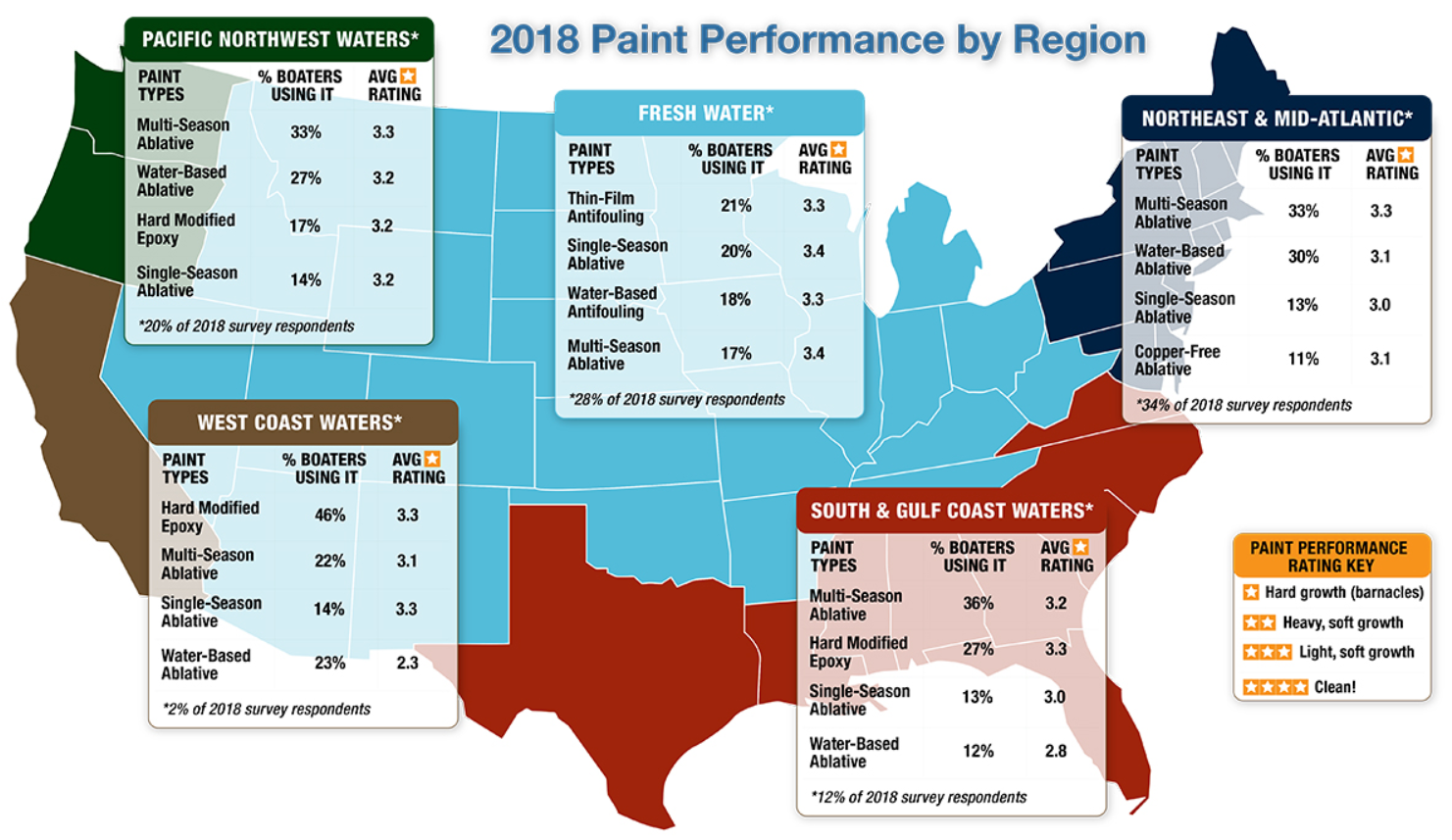


I couldn't find their live Google map, but I remember you could drill-in and read individual submissions, so asking JD for access may prove useful if you are interested in what boaters reported using (and their ratings) in specific regions of the world.
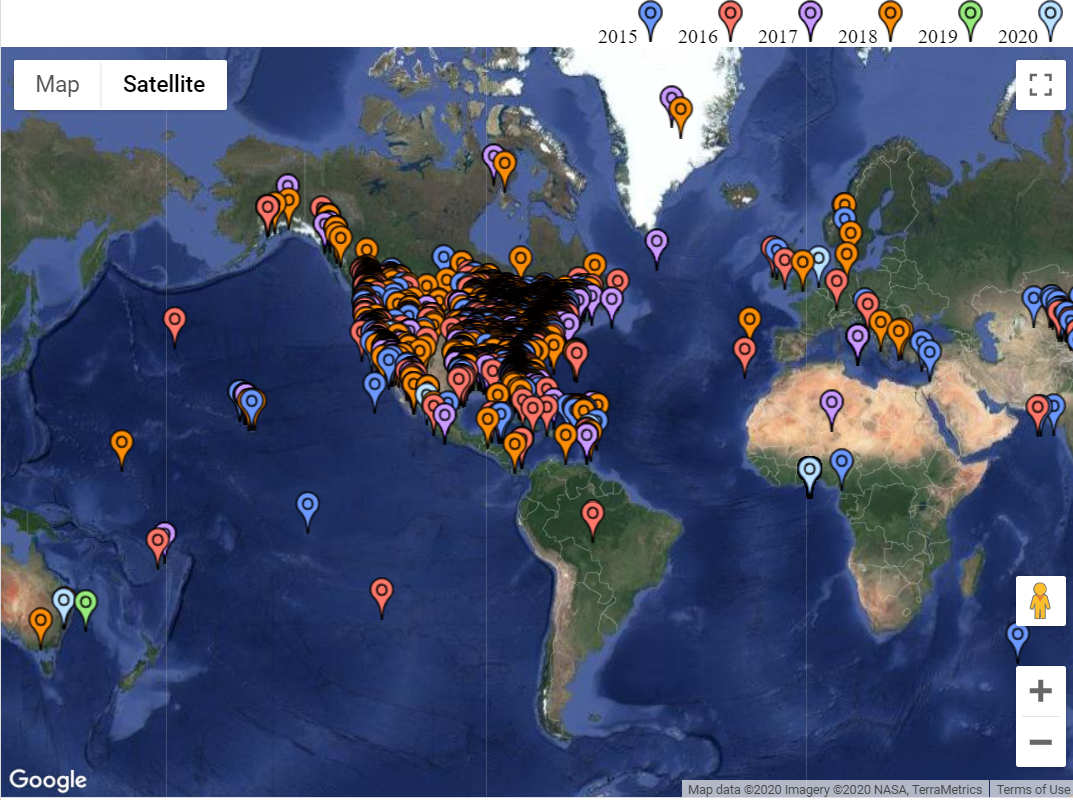


I recall using a hard, high copper bottom paint (Trinidad?) when I spent 7 years in the S Pacific tropics decades ago on a different boat. Cleaning the bottom monthly was good exercise...


More FWIW info.

July 29, 2022

Friday Funny 07-29/2022 (Bears, Glaciers, and Tourists, Oh My!)

We were in the neighborhood, so even though we've been to Glacier Bay Natl Park three times, we decided to go again. Each trip we spend time in just a few areas, so there's always something else to explore each time we go back. You must get a permit from the National Park Service, and the Fairweather visitor's guide is the resource for the park restrictions for ships, boats, kayakers, and campers. You can download it, and/or pick up a copy in the Ranger Station in Bartlett Cove. You must also attend or watch online the latest instructions, and radio when you're entering the park, as well as leaving. 


The Fairweather visitor's guide.


Or first anchorage was Berg Bay, we anchored in the back by a stream hoping to see wildlife, specifically bears, you can't help but see otters, they're everywhere. We were there two nights, and had pretty much given up, when Bill looked out the window during his morning coffee, and there was a brown bear grazing on the beach. He was turning over the rocks at low tide looking for goodies to eat.

He's a bit scruffy looking.


Gus is intently watching!

The next anchorage was Reid Inlet. This inlet has the large Reid Glacier at the head, it was once a tidewater glacier, but it appears to have receded, and isn't one anymore. 

Reid Glacier


We watched a couple of brown bears foraging on the beach one evening, and a seal floating by on his iceberg bit. 


I wanted to go back and see the Margerie Glacier, so we cruised up Tarr Inlet. This is one of the highlights of the park, all the cruiseships, small and large, the day sightseeing boats, and most personal cruisers put this on their destination list. 


Those power catamaran sightseeing day boats come from Juneau, and the park hotel, they are noisy, and throw a large wake. We can always hear them coming, and prepare for a wake jostling if needed. We've given them nicknames, Breaking Wind, Juvenile Delinquent, and Mad Max. It's not uncommon to hear us say, "Here comes Juvenile Delinquent!"

I have quite a few photos of the Margerie Glacier, I'll try not to post too many. 😀


Eating lunch, while floating in front of the glacier. Always keeping an eye out for calving, and bergs. 

This glacier extends beyond what you can see.


Bill decided to anchor in a small bight near the top of Tarr Inlet. We kept vigilant to spot out the bergs, but also, we got to net up small pieces to put in our cooler, and for G n Ts. Nothing like drinking with 100 year old ice!


Bill is using an actual ice pole that was gifted to us by our french friends, on S/V Tonga. They used it to move icebergs out of their way when they transited the Northwest Passage in 2017. See sharing the bay with 10,000 of our closest friends in the background.

G n T with glacier ice.

We had some great views from this anchorage, and listened to the glacier crack and moan. There was always new ice in the water everyday. 

Looking towards the glacier

View across the bay.

Many spectacular waterfalls.

On the way out, we stopped in Blue Mouse Cove, it's also a popular anchorage. We watched a brown bear sow, and her new cub on the beach. At one point Bill wondered where the cub had gone, I told him that the cub had crawled on Mom's head, so it was hard to see. 😁

She's the blondest brown bear I've seen.

"Hey MOM, look at me!"


And then this happened. This boat could see that we were standing there with our binoculars out, watching something. They drove in front of us twice, once I could see, but twice? Then they anchored right between us and the bears, really! Some people's children....

The bear was keeping an eye on them, and finally decided she had enough of humans, and walked off into the trees.


Bears, fireweed in bloom, and ocean, what could be more Alaskan? 

We saw a few whales in the park, but they were mostly in the distance, and no photos. We usually see more whales out of the park than in it. This year was definitely the trip for bears. 


As always, we enjoy hearing from you, either here in comments or on our Facebook Denali Rose Sailboat page.

November 14, 2021

Friday Funny 10-12/2021 (Otters, Moose, and Bears, Oh My!)


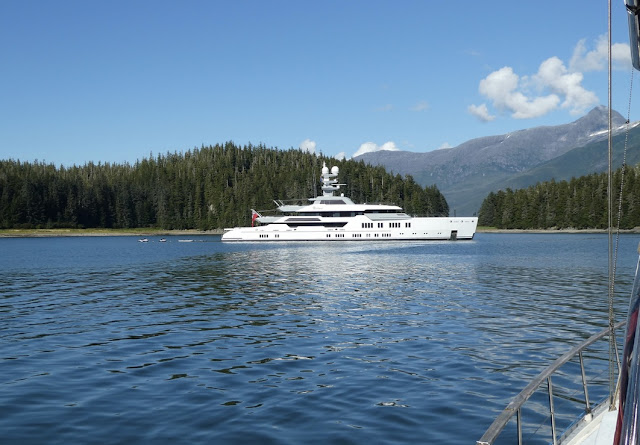
 Our next anchorage was the no name cove at the head of Tracy Arm. Many boats use this small cove as a jumping off point to the Sawyer Glacier. Here's a vessel we shared it with.

Check out the line of "toys" tied in behind, jet skis, and kayaks for guests. When underway, all the toys are stowed inside a garage in the aft section of the boat.

Note the size of the 50ft boat in the distance, and the float plane that is bringing a new set of guests. Even though this was a large charter vessel, they were very respectful of others, their genset was super quiet, and their guests left the cove to zoom around on the jet skis.


We cruised to Juneau, so I could fly to Anchorage for a week of family, and fun. We stayed at my brother's cabin on Big Lake, (an hour north of Anchorage), and enjoyed popcorn, margaritas, and good company.

An incredible rainbow one evening, it circled all around, and reflected in the water.

A side story. My earliest memory is falling off of a dock at Big Lake when I was two years old, my two older brothers hauled me out of the water. I can still see the weed covered pilings in my memory, and you can imagine how this event has colored my reaction/interactions with bodies of water ever since. Believe it or not, I'm not really a "water person". This is the dock.

I returned back to Denali Rose, and we left Auke Bay headed towards Glacier Bay. The weather started out calm, and then we rounded Mansfield Peninsula on Admiralty Island. 


This is the area where Lynn Canal, Icy Strait, and North Chatham meet. Wind, waves, chop... we were taking waves over the top of the dodger, and bimini, and we were estimating 5-7 foot waves on very short intervals. Gus was very seasick while I held him in the cockpit. Poor kitty.


Bill duct taped the cabinets in the galley closed so they wouldn't bang open, and shut. We took refuge in Swanson Harbor on a state float, and that was the end of the rocking and rolling.


Gus was a much happier kitty on our way to Glacier Bay the next day.

Gus is comfy in Bill's fleece.

At the entrance to Glacier Bay, we were surprised by a major migration of sandhill cranes.


We saw flock after flock of cranes overhead, it was thrilling. If I were to estimate how many birds flew by, I'd say over 500. So cool. 


We love going to Glacier Bay in September/October. Most of the restrictive rules have ended, and almost all of the tourist, and cruise ships are gone. 


Otters are always cute.


We knew there was another storm coming, so we found a good bight at the then of Geikie Inlet, and set the anchor well. This isn't a well used anchorage, but we saw wildlife everyday, and even with the storm, we enjoyed our time. 


The glacier across the bay.


Black bear fishing


FAT brown bear


Getting ready for a nap on the beach


We saw bears everyday, sometimes multiple bears, at a time. 


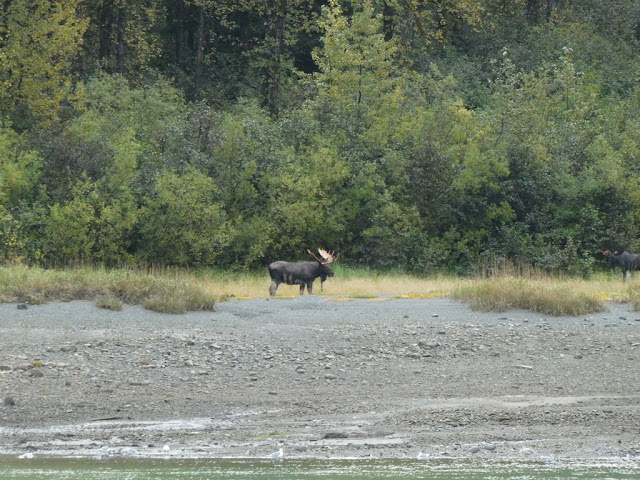
And moose, we had two bulls come down to the waterline to forage. That's kind of unusual, moose typically eat willow, aspen, leaves, bark, and twigs. I didn't think they would eat kelp. We also had the usual company of porpoise, and otter.


My new favorite Glacier Bay hat. 😀

As always, we enjoy hearing from you, either here in comments or on our Facebook Denali Rose Sailboat page.